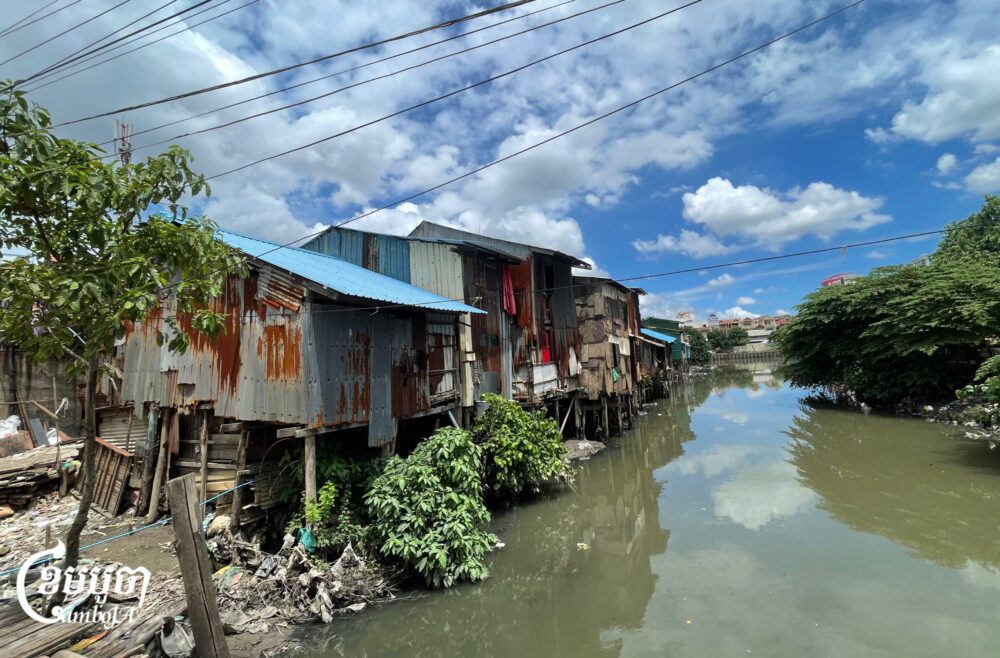
About 12 Samaki Rong Roeurng households near Boeung Trabek in Phsar Deum Thkov commune, Chamkar Mon district decried the low compensation of $1,000 to $3,000 offered to them, pleading for more equitable assistance or alternative land. They have been given time till June 22 to vacate their home as announced by the district authority on June 13.
A flood mitigation project, including a sewage system and water discharge system, is underway in their area to improve the drainage system in Phnom Penh. The Phnom Penh Capital Administration measured the villagers’ homes and invited them to a meeting to discuss compensation in April 2024.
At the time, the authority offered compensation of $1,000 to $3,000 for small houses, and $6,000 for big ones, based on the size of their homes.
According to the Phnom Penh Capital Hall, 131 households in Boeung Trabek will be affected by the development, and that settlement was completed as of August 2024. It added that residents accepted compensation from the Ministry of Economy and Finance in exchange for moving out “voluntarily” to avoid any impact from the project.
Nou Him, 47, a potato seller, who has been living there for more than 20 years, said she only has a residence certificate, family book, voter ID card and identity card, but not a title deed.
She did not accept the $1,500 compensation from the Chamkar Mon District Authority because it was not enough to build a new house. She questioned why the authorities do not consider providing better options and solutions to poor Cambodian citizens who are “only asking for a decent shelter near the city”.
She told CamboJA News that she is not against the development, but was just asking for reasonable compensation. “This compensation is too little, I can’t accept it. The eviction is very bad. We are not stopping development. We are willing to leave this place, but I only ask for land for us to live properly,” said Him.
It would make things worse if the eviction happens this week because the compensation is not enough to buy “even a square meter of land”, she said, urging the government to reconsider the compensation mechanism for residents who have been living in the area for a long time.
“At the moment, I don’t need to rent a room because I have a small house. The income that I earn is just enough to live for one day. So, without a shelter, my life will be more miserable,” Him said.

Another resident, Khem Pov, a 58-year-old scavenger, said she does not have a title deed although she has lived there since 1993. She only received $1,200 compensation when the sewage system project started, which is not sufficient to buy land and build a new house for her and her seven children.
Pov said affected residents asked the authorities to resolve the impact of the development on them several times, but the authorities adopted the “same approach”, with no consideration about their welfare.
“$1,200 is not enough to buy even one meter of land but the authorities still paid the residents that amount. We even submitted letters to all the offices. No one responded to our problem,” Pov said.
She lamented that her life will be miserable as she would become homeless if the authorities demolished her house, asking why the authorities failed to see to their needs although they are Cambodians. Life is already “very difficult” for her, so the eviction and small compensation are bound to affect her children’s future.
“If I lost my house, maybe I would live by the road. I want the authorities to give us a small piece of land so that we can build a new house,” Pov said.
A June 13 notice by the Chamkar Mon District Administration stated that 12 families affected by the capital’s sewerage system and flood mitigation project in Phsar Deum Thkov commune have not accepted compensation.
Authorities instructed them to vacate their homes by June 22, 2025, warning that clearing works will begin after that and that they will not be responsible for any damage to property. However, residents can continue to file complaints in court even if they accept compensation or when the project is completed, it said.
Dor Samphors, Phnom Penh City Hall spokesperson, and Kean Lak, Chamkar Mon district governor, cut off telephone calls when CamboJA News contacted them.
Sahmakum Teang Tnaut (STT) Right to the City program manager Seang Muoylay told CamboJA News that “forced eviction is not a good option”. He said the problem in Boeung Trabek is not difficult to solve, as the authorities can increase the compensation, such as $10,000 per family, and provide land in nearby locations or in Chbar Ampov, behind Wat Chumphos Ka’ek, where the city hall has already arranged to distribute land to the people.
Muoylay explained that there is a lot of “leftover” state land, where many were given land to tycoons in the past. In fact, “more than 17 hectares of land were given to companies and families previously”. “So, why can’t the state distribute 40 square meters of land? Why can’t the state give it to ordinary people if the authorities are so thoughtful?” he said.
“I think the authorities, as good public service providers, should soften their attitude a little to discuss this problem with the people, so that all parties can accept it,” he added.
Expelling people on the pretext of paying compensation is “not right” as they are Cambodian citizens. “They have rights and should receive protection from the state. They need to choose a place where they and their children can work and study,” Muoylay said.