Prime Minister Hun Manet has instructed relevant ministries and institutions to consider disaster risk management as a core task to strengthen human and material resources for response, and implement the National Action Plan on Disaster Risk Reduction 2024-2028 and National Roadmap on Early Warning system.
In his letter issued on October 11 in conjunction with National Day for Disaster Management, he stressed the need to work together, while urging the National Disaster Management Committee (NCDM) to further strengthen the inter-ministerial system by developing capacity in disaster risk management and reduction by sector.
There should also be education and public awareness about disaster risks, and announcement of early warning signs of danger to the public and relevant parties to prepare them for disasters.
“The government continues to contribute to maintaining economic growth and increasing public investment in housing resilience for vulnerable families, including the establishment of social safety nets, provision of adequate and safe shelter, and ensuring timely access to risk information for all communities.”
Cambodia is one of the countries facing complex and rapidly changing disaster risks due to environmental, social and economic factors. Climate change, urbanization and environmental degradation pose serious threats to sustainable social and economic development, Hun Manet said.
The increase in meteorological hazards, more frequent and intense, is threatening lives, affecting livelihoods and disrupting community economies, as well as damaging infrastructure, he added.
In July, drought linked to El Niño affected nearly 290,000 hectares of rice fields across eight provinces, according to the NCDM.
While government agencies are monitoring El Niño effects and planning responses, farmers and experts said preparedness at the community level remains inadequate, especially in water infrastructure, early-warning information, and support for vulnerable smallholder farmers.
Bou Channak, a community representative from Samkhouy commune in Sesan district, Stung Treng province, told CamboJA News that communities vulnerable to climate change lack knowledge and awareness about disaster risk management, and who they should seek help from. Communities need more support, especially early warnings that can help them prepare.
“We need financial support for capacity building and resources to respond to any disaster in time. I am working with a local NGO and we are limited in our efforts to promote disaster preparedness,” he said. “We need collaboration with the government agencies to evacuate people in case of flooding.”
Channak added that local authorities should strengthen flood and drought management by improving water infrastructure and monitoring the living conditions of vulnerable households, and helping communities become more resilient to climate change and other disasters.
Meanwhile, NCDM said in terms of disaster preparedness, it has urged relevant agencies to closely monitor weather forecasts, temperatures and rainfall, and share timely updates through the ministry’s 1294 early warning hotline and other communication channels.
NCDM spokesperson Soth Kim Kolmony did not respond to requests for comment, but he had earlier told local media that his unit has instructed local authorities to pay attention to disaster risk management. They are working in tandem with relevant agencies to help vulnerable people affected by natural disasters.
Tum Poeurn, a farmer in Ou Ta Ki village and commune in Thma Koul district, Battambang province, said that rice fields in the area rely on water supplied from the Kamping Puoy Reservoir to downstream channels. He stated that during El Niño, his six hectares of farmland was affected by drought due to lack of rainfall.
Poeurn tried to recover his rice field by using fertilizers for plant growth and productivity but bemoaned when it was affected by flooding, exacerbated by the absence of a proper channel to release the water. “I took out a loan to buy fertilizer and pesticide to revitalize my rice field and recover the losses [from the drought], but now I cannot harvest my crops,” he said.
“I don’t know what to do and I don’t know where I can get new seeds to regenerate my rice field. I owe money from buying fertilizer and pesticides and other costs, but I don’t know how I can pay them back,” Poeurn lamented.
The challenges he faces are directly linked to climate change and a poor irrigation system linking an upstream water source. He said there is no proper infrastructure to release the water during flooding and channels that receive water from the Kamping Puoy Reservoir during drought periods.
Meach Sovannara, president of New Generation Party, said that relevant ministries need to work together to improve national disaster management policy, noting that Cambodia needs human resources and finance to support this policy.
To prevent unprecedented national disasters, such as flooding and drought, Cambodia has to implement a national disaster management plan with relevant ministries and institutions. “At the same, each institution needs human resources to
address these issues,” he said. “Financial support is also crucial for institutions as emergency response materials need to be prepared in the event of flooding or drought.”
Similarly, infrastructure is vital for effective disaster response. Reliable roads, bridges, water systems, shelters and communication networks help emergency teams reach affected communities, deliver essential supplies and keep people safe, Sovannara said.
Climate change could reduce gross domestic product (GDP) by 2.5% by 2030 and as much as 9.8% by 2050, the Environment Ministry said. Cambodia is highly vulnerable to floods, droughts, storms, heatwaves and seawater intrusion.
Yong Kim Eng, president of the Citizens’ Center for Development and Peace, told CamboJA News that institutions and local communities must work together to improve flood and drought management. This includes strengthening local infrastructure and monitoring household living conditions to reduce housing-related risks, support vulnerable families in protecting themselves, and build community resilience, he said.
“We need to respond to national disasters in time to reduce the risk of vulnerable people. With more frequent disasters continuing to put people’s lives at risk as well as economic wellbeing, I think building community resilience must be done based on geographical location,” he said.
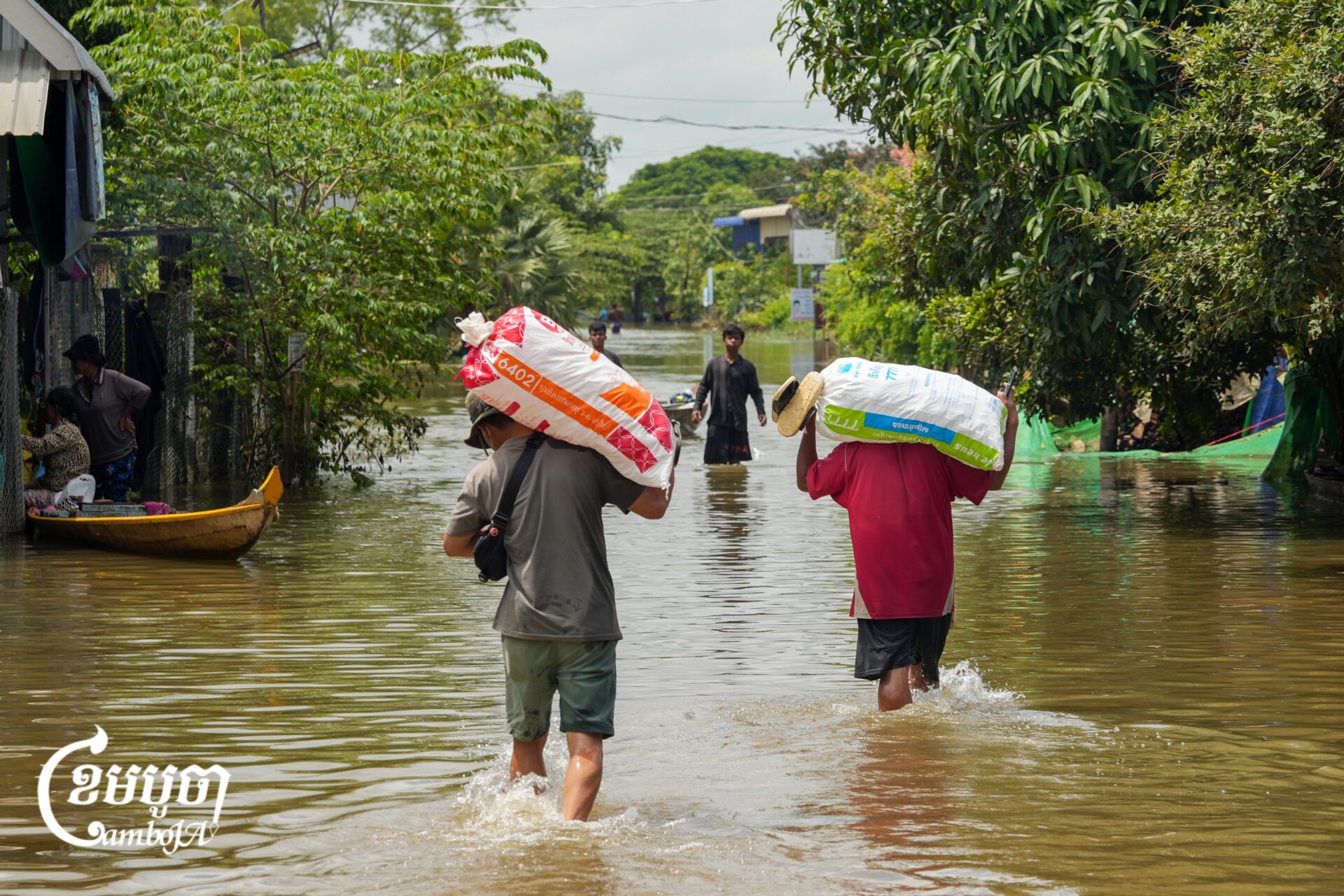
As of September 2026, 150,000 hectares of rice fields were flooded, accounting for around 5% of three million hectares of wet-season rice in the country.
NCDM figures showed that more than 57,000 affected families in 10 provinces were evacuated, with Battambang, Banteay Meanchey and Siem Reap among the hardest hit.