Listen to the audio version of this article (generated by AI).
Civil rights groups criticized the authorities for continuing to deny requests to hold public gatherings, including celebrations to mark the anniversary of the Paris Peace Agreements which itself upheld freedoms of expression.
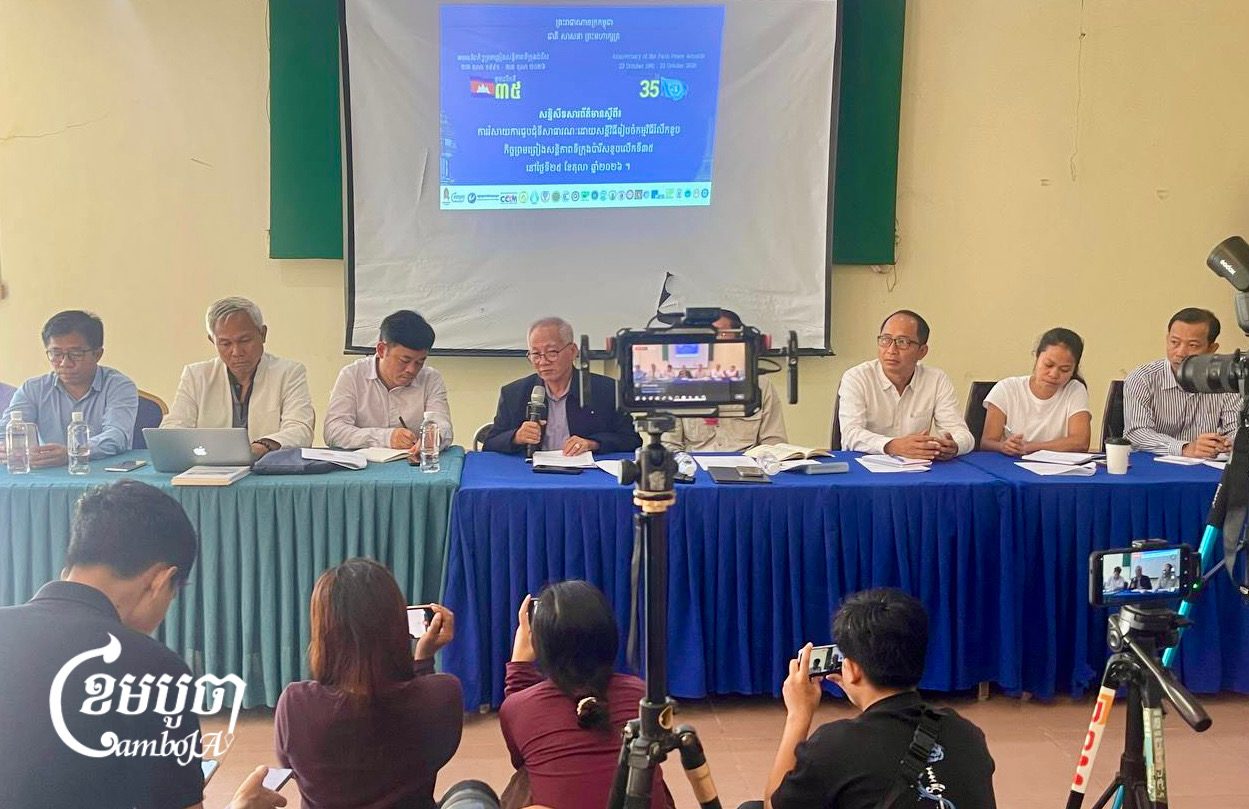
More than 500 people planned to gather to mark the anniversary at the Council for the Development of Cambodia park (CDC), but the organizers decided against it, holding a news conference instead on Sunday at the Community Legal Education Center’s headquarters in Phnom Penh, where they urged the government to open civic space and freedom to gather.
In 2019, organizers were also denied permission to march from the CDC, and held their event at the relocated Freedom Park on the city’s northern outskirts. That year, the government removed the October 23 Paris Peace Agreements Day from the list of public holidays.
Ny Sokha, president of rights group Adhoc, said civil society organizations, human rights groups and political parties have repeatedly sought permission to gather at Freedom Park to exercise their right to expression and hold peaceful demonstrations, but requests have been rejected by Phnom Penh City Hall over the years.
“Does this reflect freedom?” he asked, calling on the government to clarify the limits of citizens’ rights so people can exercise their freedom without fear of arrests or punishment.
“I want this explained so as to avoid a situation where citizens are allowed to exercise their right but authorities deem it wrong. However, citizens believing they are right are then arrested by the authorities,” Sokha said.
He pointed out more than 100 people have been allegedly imprisoned for expressing their opinion, calling the authorities to release them as they were only exercising their right and participating in activism.
Sokha said the historical importance of the Paris Peace Agreements, signed on October 23, 1991, was that it helped to establish a framework to end the conflict and rebuild the economy.
The agreements were signed in Paris by Cambodia’s four warring factions at the time and 18 other countries. The agreements committed the country to a liberal, multiparty democracy with protection for human rights, paving the way to a U.N. transitional administration and elections in 1993.
Opposition groups and rights advocates have long said that the government “has not fully honored” those commitments. They point to the court-ordered dissolution of the main opposition Cambodia National Rescue Party in 2017 and the jailing of activists.
However, Justice Ministry spokesperson Em Chankakara told CamboJA News on October 21 that authorities and judicial institutions “do not arrest or charge any individual based on ordinary speech or exercising opinions”.
“All legal actions are taken based on clear investigations into malicious intent and elements of offense as stipulated in the Criminal Code,” he said.
Meanwhile, Ath Thorn, a labor union representative, viewed that the authorities’ decision not to allow celebrations to mark the 35th anniversary of the peace agreements was a “negative development”, given the significance of the event to Cambodia’s history.
“Generally speaking, it is simply not good,” he said, adding that October 23rd marked the restoration of Cambodia’s honor and prestige after over a decade of violence and internal conflict.
Even the French embassy reaffirmed France’s support for the Paris Peace Agreements with regard to the Francophonie summit scheduled to take place in Cambodia this November, Thorn said.
He said the agreements remained important to the country’s development and the broader society.
Chhan Sokunthea, an executive director of Cambodian Center of Independent Media (CCIM), expressed concerns that restrictions to freedom of assembly contradict the Constitution because Article 41 clearly allows people to gather.
“But in reality, when we express our opinion, arrests and harassment occur,” she said. “We have seen that the situation of freedom of assembly and expression [is limited] when we participate [in events] or exercise our opinion. There is a lot of fear.”
Citing the situation of local communities, she mentioned that harassment exists not only at the national level now, but also at the grassroots level where community members who actively express opinions or work with civil society organizations are monitored.
Phnom Penh City Hall spokesperson Dor Samphor declined to comment on the views made by civil society, saying it is the right of the speakers to speak their mind.
“I do not have any comment in response to their views because it’s their right,” she said.
Government spokesperson Pen Bona said that freedom of expression and freedom of the press in Cambodia are guaranteed by the Constitution and are within the legal framework as long as they are expressed in accordance with the law.
“We see that freedom of expression always has limitations. No country or place allows us to do anything beyond the legal framework,” he said.
He urged civil society groups, journalists and activists to exercise freedom of expression responsibly and in line with the Constitution and international laws by avoiding baseless accusations and defamatory comments that harm people’s dignity.