Over 150,000 students are unable to attend classes as schools remain closed while many continue to live in refugee camps despite the ceasefire deal following five days of heavy fighting along the Cambodia-Thailand border.
The Ministry of Education, Youth and Sport and foreign partners including World Vision and UNICEF Cambodia are scaling up humanitarian aid to support displaced children and families faced by risks to their health, safety, and education.
Education Minister Hangchuon Naron confirmed that 150,000 students and 6,500 teachers have been affected due to the conflict, which caused the closure of 600 schools in Preah Vihear and Oddar Meanchey provinces.
“Some 150,000 students are not able to attend classes, significantly affecting their studies,” said Naron during the handover of UNICEF-supported study materials to displaced students in Preah Vihear province on August 1.
He said emergency measures have been introduced even though schools are closed and the situation is still unsafe.
“The ministry has distributed study materials to help students continue learning on their own, and in areas where learning is possible, special classes have been organized,” Naron said, adding that it is to ensure that the new academic year begins on November 1, 2025, allowing students to return to class.
Since the deadly clash on May 28, and the flare-up on July 24, which saw artillery attacks and air strikes in the five days of fighting, 120,000 civilians were displaced in five provinces.
Families continue to take refuge in schools, pagodas, and makeshift camps, made only with plastic sheets or salvaged materials for protection.
Preah Vihear Education Department director Chey Limhann said the situation remains tense, causing fear among families, some of whom are reluctant to send their children to school.
He said this could lead to significant losses in education as many students have lost motivation to study.
“We don’t expect attendance to return to previous levels because the current situation may cause students to lose interest,” Limhann said.
Since the fighting erupted, all 61 schools in Cham Ksan district, including kindergartens, primary, secondary and high schools have been closed as students and families flee to safe centers.
Currently, only kindergarten and primary students in shelters and pagodas, and those living in tents are being taught, with classes divided into two shifts. One shelter center has five rooms, and has organized students by grades to study in consecutive sessions.
However, there are no proper facilities for secondary and high school students.
“We have up to 1,000 students and only 18 teachers available daily, which makes it difficult,” Limhann said.
The temporary arrangements will remain in place assuming the conflict continues. Once schools reopen, students will attend supplementary classes to catch up.
“I’ve instructed school principals to manage the teaching schedule at safety centers so that students can continue learning during this period,” he said.
“During this school vacation period, we won’t let them rest – we’ll get them to attend supplementary classes. I have assigned school principals at each school to manage students at the shelters to continue teaching,” he continued.
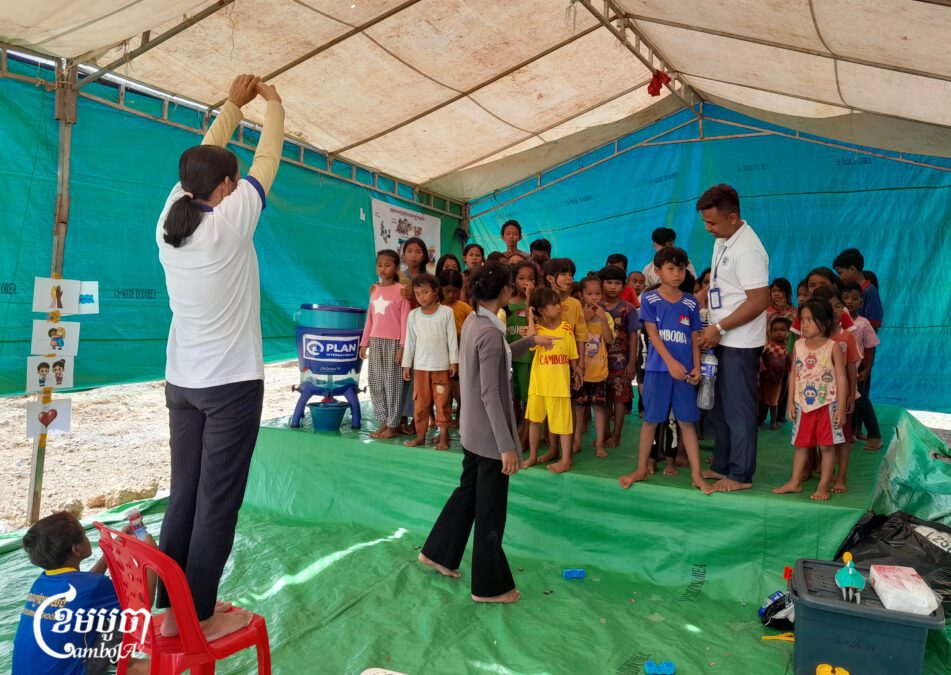
Dit Nat from Cham Ksan district in Preah Vihear province has three children in kindergarten, and grades two and five, who are currently studying in the makeshift camp despite difficult conditions.
“I don’t expect them to learn much because there are too many children and only a few teachers. The space is small and it doesn’t look like a proper classroom,” she said.
“It is really difficult to learn. As for my son, he doesn’t want to attend school. Even though I force him to study, he doesn’t want to go. He says there are too many people in the learning space, making it difficult for him to study,” Nat said.
Some children also do not want to study because they observe the tense situation around them, and living and learning conditions are challenging, she remarked.
“I just want the conflict to end so we can go back home, back to farming, and quickly get the children back to school again. My children are not studying enough,” Nat said, adding that lessons in the camp started a week ago.
The conflict has made everyone afraid and exhausted, notably children who are unable to attend school in difficult circumstances, while the teachers find it hard to teach the children there.
Another evacuee, Man Thong, who fled from Oddar Meanchey to stay with her relative in Siem Reap province since July 24, said her seven-year-old grandchild is not able to attend school.
“If the situation continues like this, young children won’t be able to study properly. If schools remain closed for long, they will face educational abandonment. They won’t want to return to school,” she said.
Thong said she decided to stay with relatives because the condition in the shelter was difficult and overcrowded.
Oddar Meanchey deputy governor Met Measpheakdey said the provincial education department has distributed textbooks and other learning materials so that students study on their own in the camps.
He added that the department, in partnership with education-focused NGOs, has also arranged for teachers to conduct lessons at the shelters.
World Vision Cambodia National Director Janes Imanuel Ginting visited the camp in Preah Vihear to hear from families displaced by the conflict. The organization ramped up aid last week by providing drinking water and sanitation facilities to the people in the camp.
“World Vision has worked with the provincial education office to set up a child-friendly space where children can come and play,” he said.
“We’re also supporting other programs by providing non-food items like mosquito nets and blankets so that families can feel a bit more comfortable under challenging circumstances,” said Ginting.
The camp sites are located 100 kilometers from the border, with one Preah Vihear camp being the largest—hosting about 15,000 people—the majority of them children, he said.
“Displaced families, mostly children, live in makeshift shelters, facing urgent need for food, clean water, health care, and access to education,” said UNICEF representative Will Parks, who visited the camp in Preah Vihear.
In a post on August 3, UNICEF Cambodia in partnership with the ministry transported 605 education and recreational learning kits to children affected by the crisis.
The kits include “school-in-a-box” supplies such as study tents, whiteboards, drawing books, stationery, football, volleyball, and other essential materials.