Despite the Ministry of Labor’s mediation efforts in the long-running dispute between Naga World employees and the management, the Labor Rights Supported Union of Khmer Employees of NagaWorld (LRSU) say the process has failed to deliver justice. They argue that mediation has not provided a fair solution for workers and union members, with the ministry instead urging them to settle the issue in court.
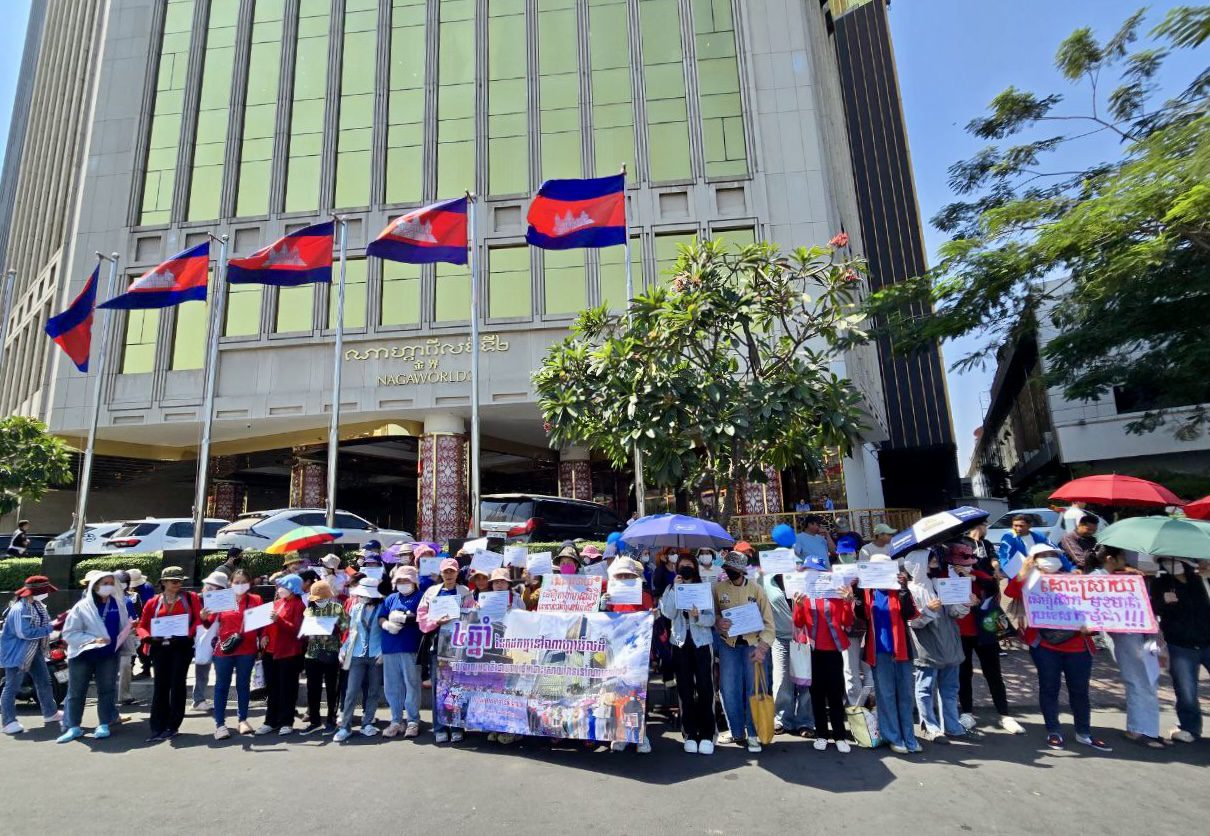
About 70 workers gathered to protest on the morning of February 1, 2026, holding banners, calling for labor laws to be respected and for renewed negotiations to bring an end to the dispute. Workers chanted slogans, urging the management “not to use money to buy rights”, “stop union discrimination in the name of investment”, and that “NagaWorld must reinstate LRSU leaders and members and pay severance in accordance with the law.”
The protesters sang union songs, played hand-held drums, and cited the 2023 ILO Declaration, affirming the activities of the LRSU and that it should not be obstructed.
Men Sothyvattanak, a card dealer at NagaWorld for eight years, said the continued protest indicate that the dispute has not been legally resolved. Even with the call for a legal settlement by the International Labour Organization, workers have faced legal action, including the arrest of union leaders, she remarked.
She added that the dispute has dragged on for over four years, urging the government—particularly the Labor Ministry—to intervene, noting that the institution has a duty to serve the public and help restore national unity.
“This is a labor dispute, yet after four years there has been no solution, only excuses and accusations against workers,” Sothyvathanak said. “The state must stand with the people. When people face problems, the state must resolve them. Previous negotiations only delayed the issue, leaving workers deeply disappointed.”
She added that instructing workers to pursue court action is not an appropriate solution, as there is no labor court in Cambodia and workers do not trust the system to deliver justice. She called on relevant institutions to intervene transparently and fairly to protect workers’ and unions’ rights.
Last month, unionists renewed demands for the reinstatement of dismissed employees, the clearing of criminal records for union members, and respect for labor rights, describing the dispute as a test of Cambodia’s commitment to justice and human rights.
The protest in 2021 led to the arrest of more than a dozen LRSU members, including their president Chhim Sithar, who was sentenced to two years in prison on incitement charges—a case that drew condemnation from international human rights organizations.
Sithar, who received human rights awards from the U.S government, said the renewed appeal reflects a lack of progress in legal demands since 2023. She accused the ministry, which acted as mediator, of repeatedly urging workers to accept compensation and end the dispute, without addressing legal protection for workers and unions.
“Overall, there is no solution for workers, only pressure to accept compensation and stop the strike,” Sithar said. “If the law was properly applied, the dispute could be resolved by the Ministry of Labor alone. However, the law has not been enforced against the company.”
Responding to the claims, the Labor Ministry spokesperson Sun Mesa said that they have already resolved 27 times, which has already shown the ministry’s will. Mesa further stated that if there is no political propaganda or agenda behind it, adding that the option of going to court is an option in accordance with legal procedures.
Meanwhile, Sithar asserted that the dismissals were discriminatory and violated labor laws, making the case relatively straightforward, adding that she was disappointed by the ministry’s call to settle the case in court. The authorities are aware of the workers’ lack of trust in the judicial system, she told CamboJA News.
“We are unfairly accused, imprisoned, and penalized. How can workers rely on a system that has not delivered justice?” she said. “Where do workers find the time and resources to sue a company backed by millions of dollars?”
At the moment, around 80 workers have refused compensation and continue to stage protests, vowing to maintain their protest until a resolution is reached.
Yi Soksan, a senior investigator at human rights group Adhoc, said the labor dispute involving NagaWorld can only be resolved if corruption in the dispute-resolution process is addressed first. As long as corruption persists, he said, there will be no justice. However, the justice that workers have received so far has come from public awareness and recognition by the international community of their struggle.
“Justice cannot prevail over corruption. They have received justice from the world, but not from Cambodia—what they have received instead are awards and recognition from the international community,” said Soksan.