A government official said the long-awaited draft Law on Access to Information — also known as the A2I draft — has yet to be approved because the Ministry of Information is revising the Press Law and drafting a new law to Combat Fake News to ensure accuracy.
In 2023, former Prime Minister Hun Sen promised that the A2I draft law would be passed after the election, or the latest by 2025 — but it remains in limbo now.
Information Ministry spokesperson Tep Asnarith said the draft is being reviewed by the Justice Ministry before moving to the next stage. He did not specify what the next steps involve.
Justice Ministry spokesperson Seng Dyna could not be reached for comment.
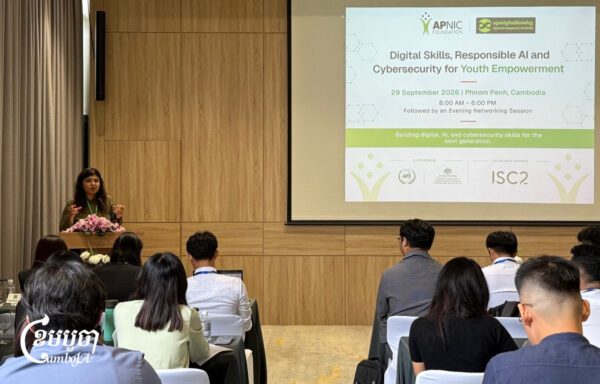
During the National Workshop on the Universal Access to Information 2025 in Phnom Penh on Wednesday, non-governmental organizations urged Prime Minister Hun Manet to expedite the adoption of the legislation to allow access to environmental and financial information.
Tun Vearayuth, deputy director of the Department of Post and Telecommunications at the Office of the Council of Ministers, said the draft has not reached the council as the Information Ministry must first complete revisions to the press and fake news law.
“To ensure accuracy, once both draft laws are finalized, the Ministry of Information will review and update the draft Law on the Right to Access Information to reflect technological developments and socio-economic changes,” he said.
He added that the Ministry of Information is reviewing the Access to Information draft law with the Justice Ministry and a group of legal experts, so the draft law has not been sent to the Council Minister Office.
NGOs have requested a revision of several articles, as well as the removal of section Article 20.7 from the draft as it says public institutions may withhold “other confidential information as stipulated in the prohibition provisions”. It has been criticized as overly broad phrasing.
Cambodian Journalists Alliance Association executive director Nop Vy said that point number seven to the highest point stipulates confidential information falling under prohibited provisions; that point is problematic, which is the main issue.
“We already know that the Law on the Right to Access Information is a parent law that guarantees access to all information that is not classified confidential or protected information,” he said.
He added that when the draft Law on Access to Information is approved, points number seven and upwards will apply to all other confidential information in other laws, and there are hundreds.
Advocacy and Policy Institute (API) director Lam Socheat said in the absence of this law, the public continues to face difficulties obtaining information directly from state institutions.
“Our civil society has consistently pushed for the adoption of the Law on Access to Information, and if there are any gaps, they can be amended later,” he said.
Socheat said that the lack of access to information can negatively affect citizens, particularly when they are unaware of government development projects, their duration, benefits, or potential social and environmental impacts — which can lead to dissatisfaction with the authorities.
He emphasized that the Rights to Access Information is a crucial mechanism for the promotion of transparency, encouraging the government to provide information in both national and international languages, as well as in ethnic minority languages, so that everyone has equal access to it.
Participant Soeun Lay from Kampong Speu province said the right to access information is crucial, especially for rural people who lack reliable information.
“If the right to access information isn’t widely available, people can be easily deceived by fraudulent schemes,” he said.
“I don’t know why it has taken so long, but we want this law to be passed as soon as possible,” Lay added.
Him Chanthy, a Kuy indigenous representative from Kampong Thom province, said that indigenous communities face significant challenges in accessing information due to low education levels and limited use of technology.
“We can usually access information related to administrative documents, such as birth certificates and other official matters, but when it comes to development projects at the grassroots level, we receive very little information,” she said.
“Access to information is essential to our daily lives so that we make informed decisions,” Chanthy added.
Ty Sokun, Secretary of the National Assembly Commission on Foreign Affairs, International Cooperation, and Information who attended the workshop, said that the legislative institution is waiting eagerly for the law.
“The draft has been in the consultation stage for ten years, but I would like to state that our participation in the consultation process reflects democracy. We want a democracy that is responsible and effective,” he said.