Listen to the audio version of this article (generated by AI).
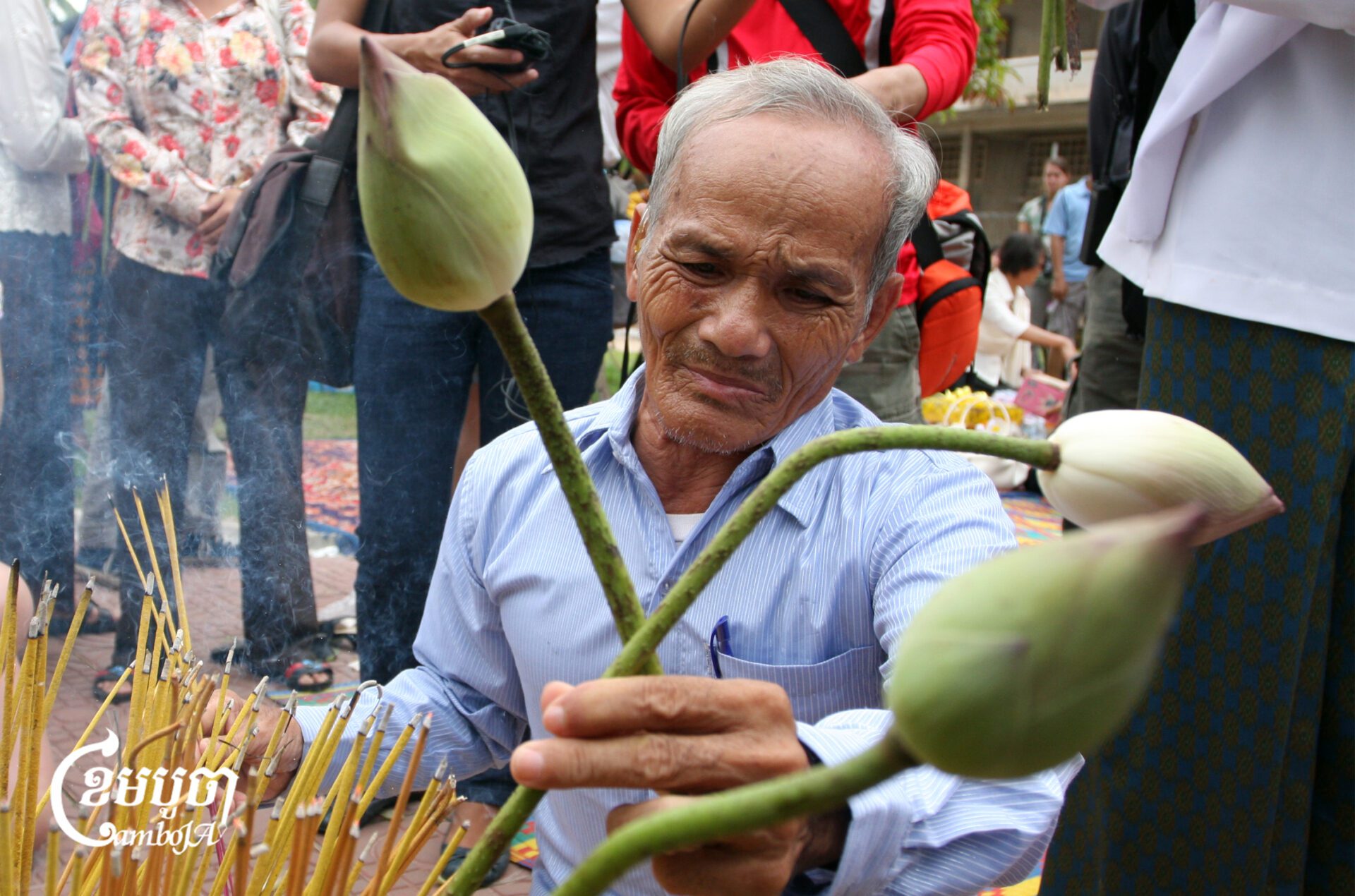
Bou Meng, artist, and one of only seven known adult survivors of the Khmer Rouge’s notorious S-21 prison, has died at the age of 85, marking the loss of one of Cambodia’s last witnesses to the atrocities committed at the torture and detention center in Phnom Penh.
According to the Extraordinary Chambers in the Courts of Cambodia (ECCC), Meng, who survived Khmer Rouge’s S-21 prison, died at 11 p.m. on August 14, 2026, the age of 85 from an age-related illness.
Meng’s granddaughter, Ny Channalin, told CamboJA News that although her grandfather is no longer around, the younger generation will not forget his testimony and historical scars.
When her grandfather was still mentally strong, he often recounted the horrors he experienced in the past, including losing his wife. Listening to his stories often shocked and saddened her.
“Future generations should remember him because he was imprisoned during the Pol Pot regime but survived thanks to his painting skills,” she said.
“Although I did not experience it [Khmer Rouge torture], hearing stories about it from my grandfather made me think about how people were imprisoned and how his wife was killed,” she said.
Despite her grandfather’s passing, her family would keep sharing his stories with future generations.
In a statement posted on social media, the ECCC described Meng as “an important historical witness” to the crimes committed during the Khmer Rouge regime, particularly the inhumane acts at the former S-21 Security Centre in Phnom Penh.
He was one of seven known survivors of S-21 because of his painting skills. The ECCC said he made a significant contribution to the pursuit of truth and justice by testifying in Case 001 against Kaing Guek Eav, better known as Duch, who was the former chairman of S-21.
Apart from his testimony before the tribunal, Meng spent years talking about his hardship at S-21 to Cambodian and international visitors, and youths.
The ECCC said his testimony and personal accounts contributed to preserving history and educating future generations about the Khmer Rouge’s atrocities.
“The passing of Mr Bou Meng represents the loss of an important historical witness to the grave crimes committed during the brutal Khmer Rouge regime,” the ECCC said.
Meng spent his later years sharing his story with the younger generation and visitors to Tuol Sleng. His life became a reminder of the brutality of the Khmer Rouge regime and the importance of survivors in preserving historical memory.
According to UNESCO, Meng was an important voice of remembrance and education in Cambodia. Through decades of experience-sharing, he gave a human voice to Cambodia’s painful history under the Khmer Rouge.
“Bou Meng’s life and testimony highlight the need to preserve survivors’ stories while their voices are still with us. These personal accounts are part of Cambodia’s heritage and an enduring source of learning for future generations,” UNESCO said.
Youk Chhang, head of the Documentation Center of Cambodia, which has an extensive archive on the travesty of Khmer Rouge, told CamboJA News that S-21 prison was one of 196 prisons established during the Khmer Rouge regime. More than 18,000 people were imprisoned at S-21, which left behind more than 5,000 documents.
He said former prisoners and people who worked at prisons during the Khmer Rouge regime should be researched and documented as part of Cambodia’s history and as evidence for the courts.
Chhang, who met Meng in 2004, described him as a lively and intelligent person who knew how to live in the present. His demise “deeply saddened” him.
Chhang said he had “many memories” with Meng and had a particularly close connection with him compared to others, making his death especially painful.
He noted that Meng’s story has been extensively documented through drawings, films, testimonies, interviews and photographs. The records have also been used in the study of Cambodia’s history around the world.
“Even if we wanted to forget his story, we can’t because it has been documented and shared for the past 20 years,” Chhang said.