Listen to the audio version of this article (generated by AI).
Indigenous Bunong families in Mondulkiri province have accused a private coffee company of clearing their farmland, burial grounds and sacred forest, prompting a formal appeal this week to halt the project, an Indigenous rights group said.
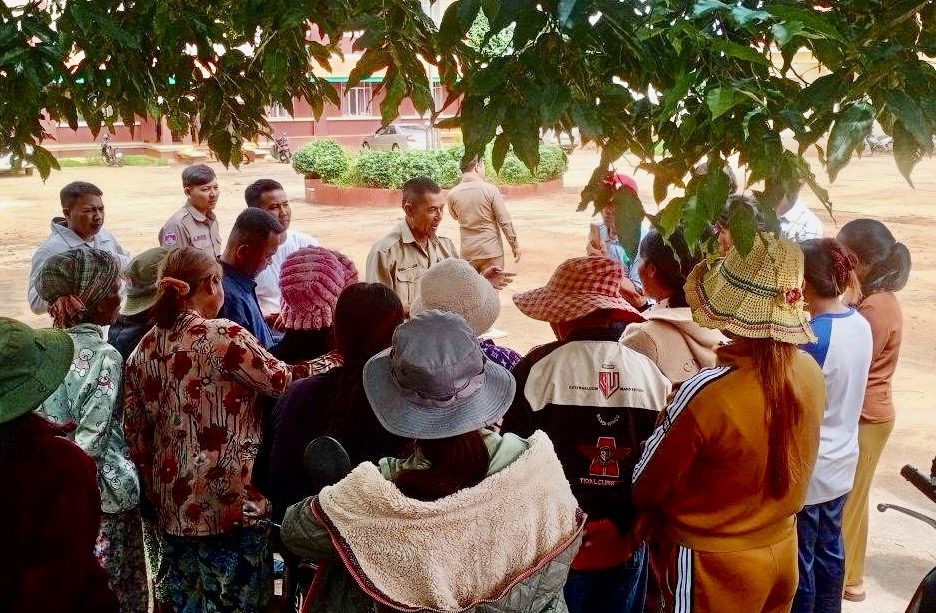
About 150 families in Pu Teurt village say Eysan Eco Zone Co. violated their rights by clearing rotational farming areas, sacred forests, burial grounds and livestock-raising land, according to residents who spoke with CamboJA News. They said the development also threatens water sources, fishing areas and forests the community relies on for non-timber forest products.
Bunong Voice, an advocacy group for Bunong communities, posted a letter on Facebook Thursday addressed to the provincial governor and signed with the thumbprints of several family representatives, calling for a halt to development.
“Mr. Governor, please review and intervene to stop granting any investment rights to private companies on these lands in order to maintain the food security, culture and peaceful living of our Indigenous communities,” the letter said.
Residents said in the letter that without intervention, the loss of land and forest access would undermine their livelihoods and leave them “severely affected by climate change” as hundreds of hectares of forest and natural resources are lost.
Eysan Eco Zone received investment and development rights from the government earlier this year for around 668 hectares to develop a coffee plantation near the village, along the Vietnam border, according to documents the community shared with CamboJA News. Choeung Kokyuang, the company’s chairman according to archived corporate records from the Ministry of Commerce, could not be reached for comment.
Pyeuy Phieng, a Bunong resident of Pu Teurt village, said the company began clearing residents’ rotational farmland earlier this week without informing them.
“The district authorities did come to inspect the site, but we have not received any information about what specific action will be taken,” she said.
Phieng said development could benefit the local economy, but that Indigenous land rights, traditions and religious values should also be respected.
“I hope the authorities will return the land to the people because it is our hope and where we farm to make a living. If the large forest is lost, we will have nowhere left to depend on for our livelihoods,” she said.
Phieng acknowledged that the community does not have land titles for the area.
Indigenous groups in Cambodia have long faced persistent difficulties obtaining collective land titles, leaving them vulnerable to land disputes and encroachment from development and commercial projects.
Another resident, Bun Thansophak said the cleared areas were extensive but difficult to estimate how many hectares were cleared.
She said Eysan Eco Zone began clearing land in February but suspended the activities for a period following protests by residents. The clearing has now resumed, she said.
Yert Sarin, chief of Bousra commune where Pu Teurt village is located, confirmed that land had been cleared as residents claimed, but said authorities had visited the site and had not yet “reached a final resolution.”
“There are two companies that have received development projects. One is having a problem with residents and the other has no problem. This issue has to be handled at the provincial level. I cannot make any decision. I can only confirm that there is residents’ farmland and a burial site there,” Sarin said. He could not confirm the name of the other company.
Vanna Mab, Pechreada district governor, where Bousra commune is located, also said authorities had visited the cleared areas, but determined that the land was “legally allocated” to Eysan Eco Zone. He claimed that residents were farming on the company’s land.
“They are not encroaching on residents’ land. The company is growing coffee and cacao, and it is owned by Cambodians,” Mab said. He added that authorities could not yet provide details about the procedures for resolving the dispute because they were still conducting an on-site assessment.
The land dispute is not the first for Bunong residents in Boursa commune. In 2008, residents alleged that subsidiaries of Socfin Group forcibly cleared and seized their farms, burial grounds and sacred forests after the government awarded rubber concessions. In the letter published by Bunong Voice, residents also claimed in 2015 another company, LKL, also encroached on farmland, but authorities later intervened.
Yin Mengly, deputy head of land rights at Adhoc, said authorities must always account for Indigenous rights when granting land concessions.
“If we do not, it means we are eliminating the identity of Indigenous peoples, and eventually there will be very few Indigenous identities left,” Mengly said.