Cambodia will file a complaint with the International Court of Justice (ICJ) to resolve the long-standing Cambodia-Thailand border dispute surrounding the Ta Moan Thom, Ta Moan Toch, Ta Krabey temples, and Mom Bei areas in Preah Vihear province.
An armed conflict between Cambodian and Thai armies in Choam Ksant district in the province due to border disputes on May 28 resulted in the death of a Cambodian soldier.
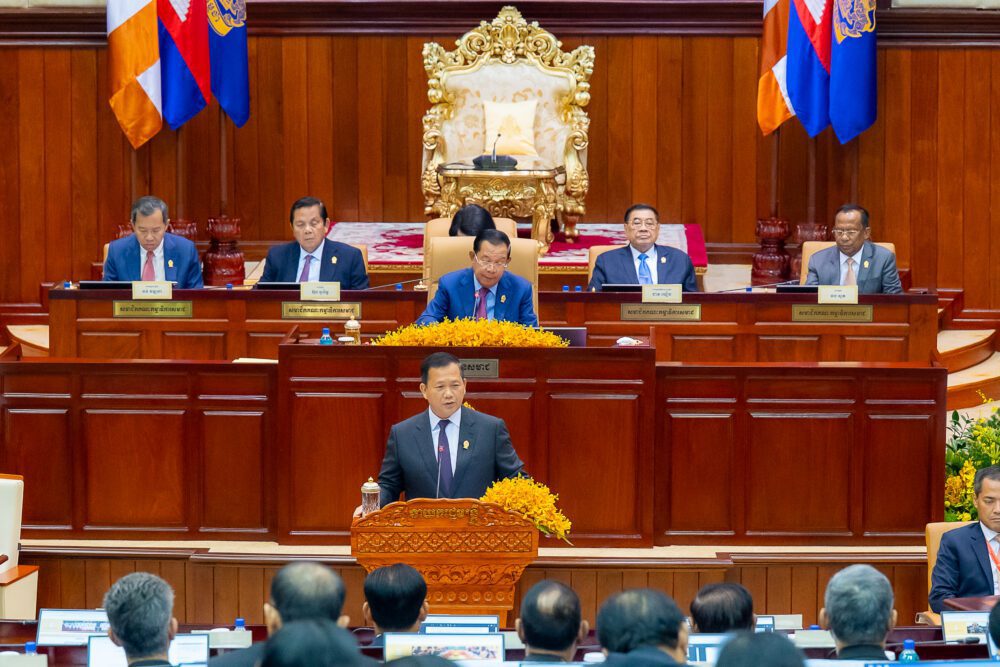
Speaking at the opening of the first congress meeting of the National Assembly and Senate on Monday morning, Prime Minister Hun Manet said in filing a lawsuit with the ICJ, it aims to stop the issue from spiraling into a new confrontation with Thailand due to the unclear border.
“Even if the Thai side does not agree to take this issue to the ICJ, Cambodia will file a complaint to end this issue once and for all to avoid any confusion, [and] especially provocations by small groups of extremists in Thailand and Cambodia that could lead to armed confrontations.”
Cambodia, via the Joint Boundary Committee (JBC), will measure and demarcate the border of the two countries, Hun Manet said, emphasizing that Cambodia will not hesitate to use force if there is a violation of sovereignty.
Following his speech, the National Assembly and Senate voted in full — 182 votes in total — for the motion to file the suit with the ICJ.
While opposition senator Kong Monika told the congress that he supports the government’s move to seek international law to resolve the land border dispute with Thailand, he asked if the government could also bring the maritime border dispute with Thailand to the international court.
Noting that both the Cambodia and Thailand maritime and land border are sensitive issues, which is “always a concern of the people, government, and political parties” and there should be a resolve to end it.
Opposition parties — Candlelight Party, Khmer Will Party and Nation Power Party — also supported the government to file the dispute with the ICJ. They also called for unity among politicians and citizens to uphold sovereignty and prevent foreign invasion.
Meanwhile, Senate president and former premier Hun Sen, who spoke at the congress, pointed out that the border issue with Thailand has persisted for 25 years, noting that the conflict can only be resolved by the court as “both sides cannot retreat for fear of the public blaming them”.
Cambodia will submit the map of the Franco-Siamese treaty of 1904 and 1907 as evidence at the ICJ, he said, adding that “Cambodia promises to respect the court’s decision”.
CamboJA News did not receive a response from the Thai Embassy in Phnom Penh at the time of publication.
Earlier, Major General Winthai Suvaree, spokesperson for the Royal Thai Army (RTA), clarified that Hun Manet’s proposal to raise the territorial dispute to the ICJ, which will be discussed at the upcoming mid-June JBC meeting, is separate from the current ground issue.
Winthai said the current issue centers on “how both sides can coexist peacefully in an overlapping claim area that has not been clearly demarcated yet”, Bangkok-based The Nation reported.
Ministry of Defense spokesperson Chhum Socheat said they have prepared “all the documents and evidence” for the lawsuit with the ICJ, confirming that the case will “only focus on the land dispute”.
Government spokesperson Pen Bona said the government will make an announcement when Cambodia has decided a date to file the suit.
Political analyst Em Sovannara opined that after the lawsuit is filed, Cambodia should seek international diplomatic support and strengthen its military capabilities.
He is made to understand that “if Thailand loses, it might not be easy to hand the land over to Cambodia”.
“Cambodia must strengthen its capabilities. If we rely only on the court, we cannot fully resolve the issue. Like the Preah Vihear case in 1962, where the court ruled in favor of the Cambodians, the Thai side did not hand it over to us, and we still used military force to seize control.
“If some Cambodians living abroad protest against the government, our leaders will lose pride. So, [the government] must ensure that the international community does not raise negative points about Cambodia.”
Between 2008 and 2011, Cambodia and Thai troops clashed in the Preah Vihear area, such as Tamon Thom, Tamon Toch, and Takrabey Temples, after Preah Vihear temple was included in the UNESCO World Heritage List following Cambodia’s successful application.
However, tensions between Cambodia and Thailand flared up again when Thai troops allegedly shot at a Cambodian trench in the early morning of May 28, killing soldier Suon Raun, the Ministry of National Defense said.