By early January 2026, nearly a month of fighting along the Cambodia–Thailand border had displaced more than 640,000 Cambodians, pushing families into pagodas, makeshift tents and shelters far from their homes. Among those most affected are children, whose education and mental well-being were profoundly disrupted by the conflict.
According to the Ministry of Education, Youth and Sport, at least 1,311 schools were forced to close at the time for the safety of students as civilian areas were targeted. The closure affected 322,103 students and 15,035 teachers across seven provinces—Preah Vihear, Oddar Meanchey, Banteay Meanchey, Pursat, Koh Kong, Battambang and Siem Reap.
Students in border provinces experienced repeated disruption after fighting broke out in July 2025 leading to mass evacuations between July 7 and 13, causing hundreds of schools to shut and tens of thousands of families from the provinces to flee to temporary shelters.
‘Doesn’t talk like before’
Education and mental health experts warn that the impact extends beyond lost classroom time. Children are not only missing lessons, but also a sense of safety and stability essential to healthy development. Parents say their children have become quieter, withdrawn, fearful and unable to concentrate.
Although the ceasefire has seen more than 700 schools reopen in five provinces, 228 schools remain closed in Preah Vihear, Oddar Meanchey, Banteay Meanchey and Koh Kong, leaving thousands of children still without access to formal education.
The Interior Ministry reported that 460,000 had returned home as of January 7, 2026, with 186,760 people remaining in displacement camps.
At the peak of the renewed conflict in December, more than 640,000 people were displaced. Thirty two civilian deaths were reported along with 94 injured and widespread damage to homes, schools, health facilities, roads, bridges, electricity infrastructure, and religious and cultural sites.
Humanitarian needs persist inside the camps and among families who have returned, particularly those whose houses were damaged or having limited access to services.
Vy Sreymom, 28, from O’Smach, Oddar Meanchey, fled with her family on December 8 after gunfire erupted to seek refuge at Wat Sampov Lun in Siem Reap. She lost her home and farmland she had had for decades.
“When I heard the weapons going off, my husband and I took our children and fled. I brought whatever I could. I never thought that the conflict would drag on for long. I thought it would be short like the first time. So, we have to rebuild our lives after the war.”
One of her children, who is in grade two, was deeply affected by the conflict. “Our children don’t go to school [now]. We’re even afraid to hear the sound of the bomb,” she said. “My son doesn’t talk as much as before and often asks when he will go home,” she said when interviewed recently.
Ny Sopharan, operations director of World Vision Cambodia, said observations from direct work in 82 refugee camps indicate that the conflict had direct and indirect impacts on children’s education and mental health.
The severity of the impact varies depending on the duration of displacement and the level of intervention provided. “On the whole, there is impact, but the extent depends on the interventions of those involved and how long the child has faced the problem,” Sopharan said.

Childhood on hold
Phay Chanthy, 32, from Oddar Meanchey, said the war disrupted her children’s education and changed their behavior. Repeated evacuation during the school year caused her children to fall behind in their lessons.
Having experienced a civil war herself in the 1990s, Chanthy felt empathy for her children. She said they lived in constant fear and had to flee attacks. Even the sound of airplanes created panic. She longed for the calm to return so she can raise her children in a safe environment and return to normal life.
“The war not only caused people to flee their homes and lose their livelihoods, but also seriously impacted children’s education and mental well-being.”
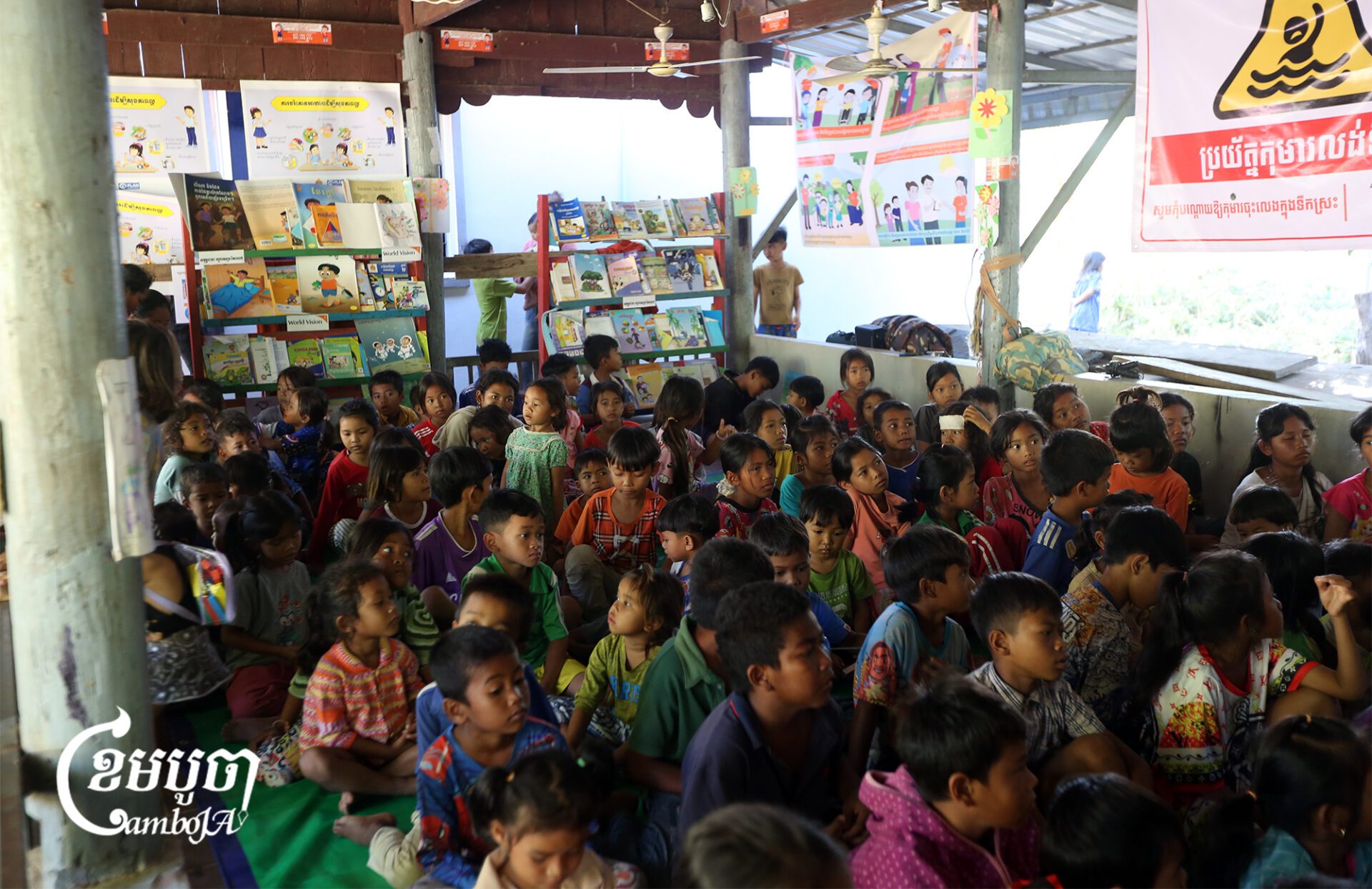
Sitting inside a child-friendly learning tent at Chroy Neang Ngourn pagoda in Siem Reap province, Se Sokchea, 43, from Oddar Meanchey, said the war has changed children’s behavior after witnessing military strikes.
“The children are traumatized. I am scared too,” she said. “I can only teach my children a little as I have to cook and also care for my elderly mother. Before the war, we didn’t worry about our children or our home, and they were learning well. Now, I worry about everything.”
Seang Lap, project coordinator at Transcultural Psychosocial Organization (TPO) Cambodia, explained that wars cause long-term psychological trauma, especially for children, who are emotionally fragile and highly vulnerable to stress. Children need a safe, supportive environment to thrive, and displacement exposes them to sadness and stress, he said.
Emergency responses should include psychosocial support and address children’s physical, psychological, and social needs. Providing such support requires collaboration among multiple stakeholders, including ministries and institutions, to meet the needs of large numbers of affected children.
“That’s why TPO advised and suggested creating a place for children to play, which is an activity that can be done in times of crisis to help them improve. We can only help 10 camps. There are many others, so we have to work together because the most important thing is the mind. If the mind is weak, there will be problems,” Lap explains.

Learning in fear, but not giving up
Sok Tha, 16, a ninth-grader from Oddar Meanchey, has not been able to study with her classmates for days as they live in a cramped camp with limited food, and no textbooks. She helps care for her younger siblings and assists with household chores, making learning even more difficult.
Despite these challenges, Sok Tha tries to persevere and study online, though the environment affects her focus, and physical and mental well-being. She described her situation as “racing against time” as other students learned in safe classrooms.
“When I ran to this place, I didn’t study much because of the conflict. It affected my feelings and made it difficult to concentrate. Previously, as long as I was in class, I could go to school anywhere. I always miss my classmates and the teachers who gave me advice,” Sok Tha said.
She added that without books or learning materials, her learning was impacted. However, she and her family were able to go back home recently, enabling her to resume classes.
“As a refugee, I had a hard time studying. We ran away without taking any books. It’s easier for those who live in provinces not affected by the war. When it was difficult, I told myself to work harder and not to stop studying because our country needs us.”
Instead of enjoying her youth, Sok Tha said she was living in fear.
“Despite being in the camp, I couldn’t sleep at night because I could hear the drones above which made me feel unsafe. I hope our country will be free from war in future and our people can return to their cozy homes.”
Similarly, Boeun Srey Ya, 13, an eighth-grade student from Oddar Meanchey province, said refugee children experienced “greater educational challenges” than those who have not experienced war. At a young age, she has had to balance studying and helping her family. She looks after her younger siblings, fetches water, and assists her mother with cooking—leaving little time or energy for schoolwork.
Being away from school has made her miss her classmates, teachers and the positive atmosphere of the classroom. Although she loves reading and excels in Khmer, fear and trauma affected her ability to study.
“I am probably a little slower now. Although learning by phone helps a little, it is difficult to use the service. I am also scared. I remember when Thailand first dropped bombs. I felt sorry for my brother and mother when we ran away. I panicked and didn’t know what to do,” she said.
Srey Ya hopes that the government would increase support for refugee children, including rebuilding their confidence and morale.

Teaching without classrooms
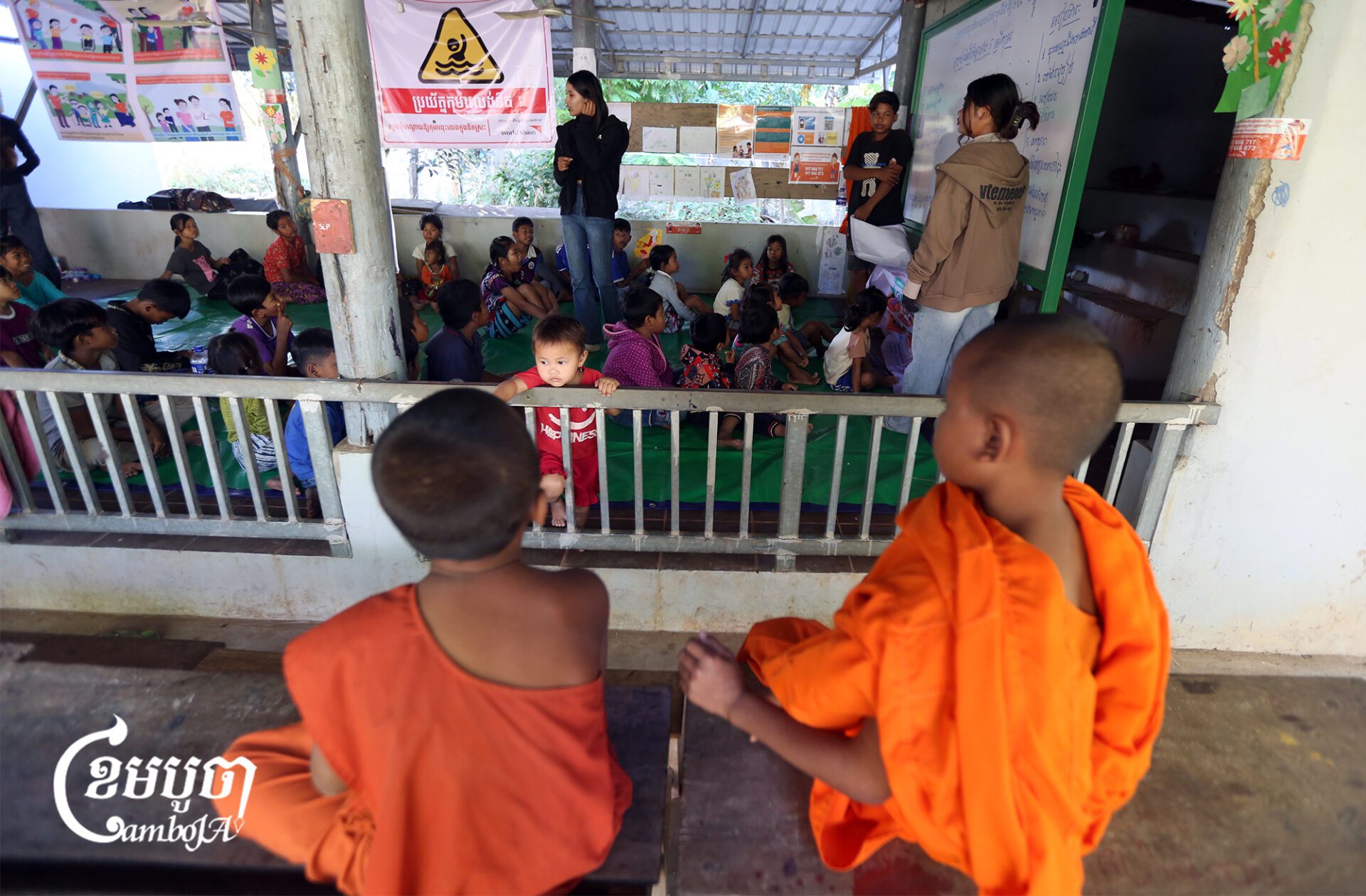
In Chroy Neang Ngourn camp, Im Sokren, a refugee teacher who fled from Oddar Meanchey province, taught grade one students although she normally teaches grade three. She taught 50 to 60 students who did not have books, study materials or desks. Their attention span and mental state was also poor, so they had difficulty focusing.
Students were taught to read and write from Monday to Saturday from 7 to 11 a.m. but they were easily frightened, she said. A day earlier, the Thai army launched bombs near the camp.
“I could only teach for two hours. It is very difficult to manage a makeshift class. When I talk to the students, they don’t listen, and they are still young. Sometimes when they hear a sound, they get scared and run away,” Sokren said.
She sympathized with the students who had to face difficult situations at a young age. They would carry these feelings and memories with them, which may affect their life.
“Even students in grades 7 to 12 have not been in school from the time they fled home. Online learning is not easy either due to problems with the phones and internet,” Sokren said.
Chhou Bunreung, director of Banteay Meanchey Provincial Department of Education, said children have lost a lot of studying time as many schools have been damaged. As a result, intellectual development is impacted.
Prior to the conflict, the border tensions scared students but the full blown conflict may have caused psychological trauma which could affect their ability to learn.
‘Cannot wait until 100% safe’
At Khnar Temple Refugee Camp in Siem Reap, Reap Luet said although she went home, her older child could not go to school as it had not opened. At the same time, she struggled to restart her life as everything was ruined.
Luet and her husband, both farmers, have two children—one in grade seven and the other, a two-year-old. “My daughter is a good student. She’s smart and wants to learn,” she said.
Yi Kimthan, executive director of Plan Cambodia, said although displaced families are returning home, the organization continues to support vulnerable groups, such as children.
He mentioned that children fleeing with their parents could face psychological trauma that may affect their mental well-being and education, which requires sustained support from relevant parties.
“We are not abandoning any child in this difficult situation. Mental health support in some camps is to provide psychological counseling and arrange play areas for children. We worked with the Ministry of Education to set up temporary schools,” Kimthan said.
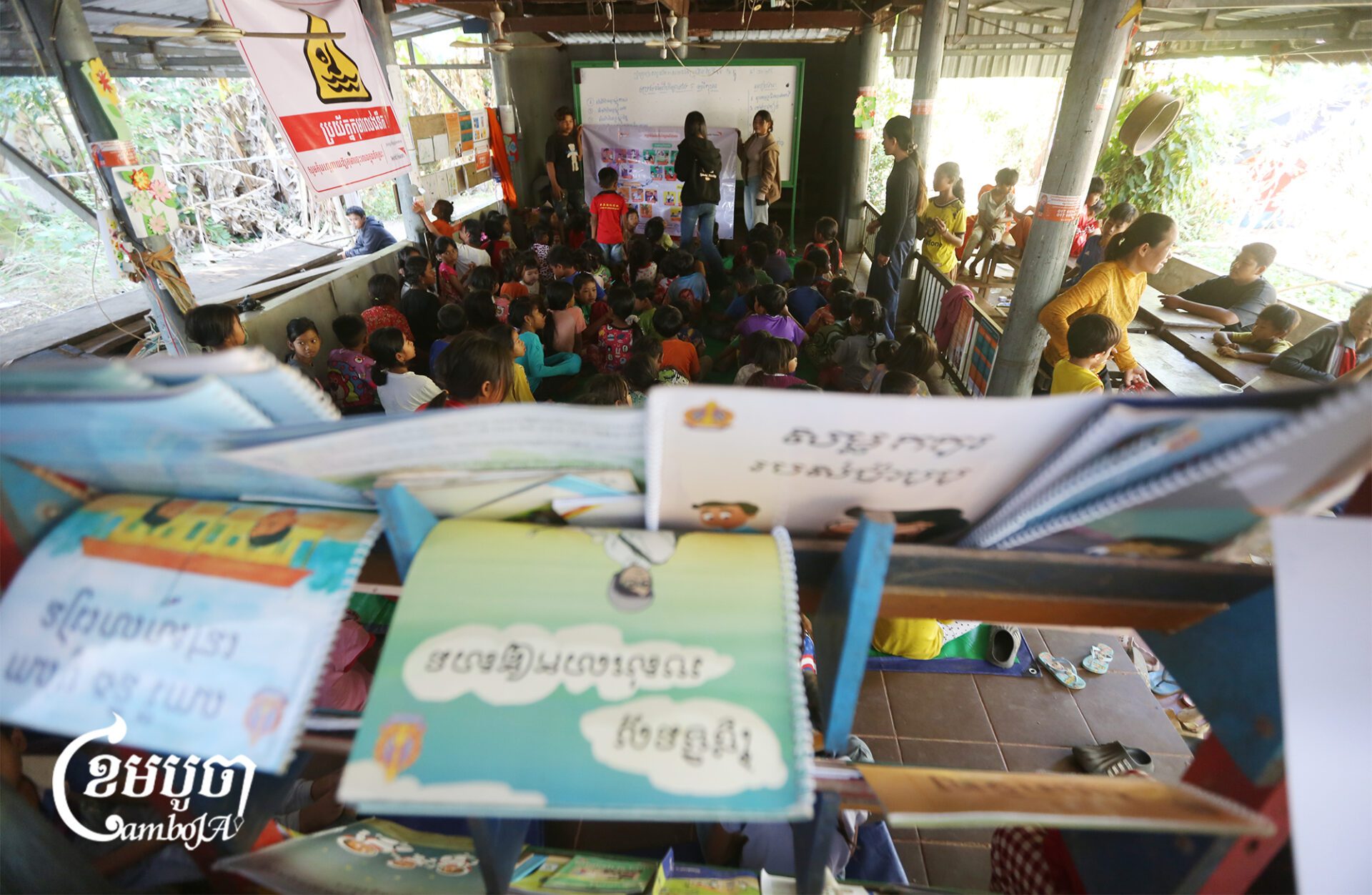
Sopharan of World Vision Cambodia said they have supported displaced communities in 82 locations in five provinces, creating 45 child-friendly spaces and 54 temporary learning centers with the ministry as well as reading areas for children to continue learning.
To provide psychosocial support, 1,200 local staff were mobilized to care for children and adults in the camps. For students who returned home, World Vision continues to assist with infrastructure restoration and improving teaching and learning through training and motivational programs.
“We have experience from the Covid period. If children need extra support, we’ll look into it with the ministry and departments. We’ll do everything we can with partner organizations and the government to create opportunities for them to continue their education and restore the quality of their learning,” he said.
Bunreung said that to help students in border provinces catch up, the ministry plans to extend school hours, while temporary learning spaces have been set up for schools that cannot fully reopen.
“We are preparing temporary learning spaces for the children because the future of the children is the future of our nation, so we cannot wait until we are 100% safe. We have to learn to live in a context of war and aggression,” Bunreung said.