Listen to the audio version of this article (generated by AI).
Indigenous communities and civil society groups in Cambodia are urging the World Bank Group to reconsider its decision on the findings by the Compliance Advisor Ombudsman (CAO) over the impacts of microfinance lending on Indigenous communities.
The groups, who made the call in conjunction with International Day of the World’s Indigenous Peoples, said rising household debt has seen families reducing food consumption, children missing educational opportunities and people migrating for work to repay loans. They also said debt has made it harder for Indigenous communities to participate in cultural ceremonies and maintain traditional practices.
The groups are particularly concerned about the use of Indigenous land as collateral for loans. They said banks and microfinance institutions have provided loans secured by land that overlaps Indigenous territories, potentially contributing to land sales and making it more difficult for communities to obtain collective land titles.
A February 2022 report by the CAO stated that they received a complaint from two nongovernmental organizations, Licadho and Equitable Cambodia, on behalf of 18 borrowers who had taken loans from one or more of six financial institutions.
The complaint highlighted concerns about the social impacts of lending and debt-collection practices by the six financial institutions and banks.
The complainants alleged that their families and communities suffered from harm because of lending and debt-collection practices by microfinance institutions and commercial banks, and that they had been pressured to sell their assets to repay loans.
“They allege that lenders did not provide sufficient information to assess the consequences of entering into loan agreements, including a lack of information in Indigenous languages.”
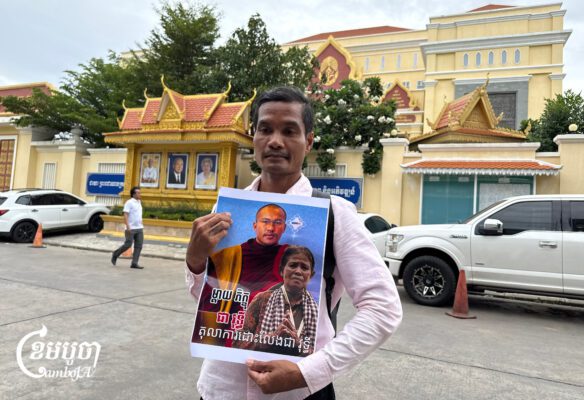
Rochom Sang, a Kachok Indigenous man from Ratanakiri province, said he borrowed $20,000 from a local bank for farming, to build a house and buy a motorcycle.
But when poor harvests made it difficult for him to make loan payments, bank employees pressured him to borrow from private lenders and sell his land to repay the bank, he said. His son was also forced to leave school in eighth grade to earn money to help with the bank loan repayment and support the family.
“I sold half a hectare of my cashew nut farm. I have paid off the debt now, but I am not happy because I have no land to rely on. I sold it because they pressured me to sell it, and my child also had to stop going to school,” he said.
Kaing Tongngy, spokesperson for the Cambodia Microfinance Association (CMA), said the banking and financial sector has introduced additional regulations to ensure responsible lending to customers.
Regarding collateral involving community-owned land, he said CMA introduced a policy about two or three years ago prohibiting financial institutions from accepting community land as collateral.
“This happened in the past because there were gaps. In some areas, land has not been systematically registered yet, so some institutions or officers relied on confirmation from local authorities that the land belonged to an individual. This caused gaps,” he said.
Tongngy added that accepting such land as collateral could ultimately result in losses for financial institutions because communal land cannot legally be sold or used as the subject of court proceedings.
CMA urged its members to avoid such problems and strengthen cooperation with the Ministry of Land Management, Urban Planning and Construction to verify land information when assessing loan applications.
Asked about the call by the civil society groups, Tongngy replied CMA had “no comment” but that CMA would accept the final decision of the World Bank’s Board of Directors.
He said protecting customers and ensuring that financial institutions and banks provide loans responsibly and transparently, as well as improving financial literacy among the public, remain key priorities for the association.
“We want to ensure that people who use financial services benefit from them and see improvements in their livelihoods,” he said.
Am Sam Ath, operations director of Licadho, told CamboJA News that civil society groups have asked the World Bank and its Board of Directors to reconsider the findings of the investigation and establish a systemic mechanism to address the problems.
“If they continue to refuse to recognize these issues, it appears to be a failure by the International Financial Corporation and the World Bank to take into account the rights of Indigenous peoples who have been affected by their investments,” he said.
The CSOs and communities said in the statement that the World Bank Group can only claim to respect the rights of Indigenous communities in Cambodia if they accept the CAO’s findings and implement its recommendations.
CamboJA News will update the comment from the World Bank based in Cambodia when they respond on Tuesday to questions sent earlier.
A World Bank Group spokesperson responding to CamboJA News said that the 18 complainants like many other microfinance borrowers often face complex situations of economic hardship.
“We believe the gaps these complaints reveal—in regulation, education and responsible finance—can be addressed through strong regulatory oversight and coordinated action, and we have invested in those solutions,” the spokesperson said.
With the Board’s action, IFC has committed to concrete measures to address concerns arising from its microfinance portfolio in Cambodia, they added.
The World Bank group said that “as described in the Special Management Action Plan”, the IFC is currently working to hire an independent facilitator to work directly with the 18 complainants to help mediate solutions between the complainant and the IFC client, including through loan restructuring, deferred repayments, or interest adjustments.
“CAO will monitor IFC’s implementation of the plan. IFC has been maintaining engagement with the CSOs representing borrowers in Cambodia, as well as technical and development partners in the microfinance space, and we will continue to do so,” the World Bank said.
IFC manages these efforts through its Financial Consumer Protection framework, which follows widely accepted international good practice in the industry. “Our ongoing work continues to strengthen borrower protections and promote responsible lending across Cambodia’s financial sector,” they said.
This story was updated at 3.45pm on August 11, 2026 following a response by a World Bank Group spokesperson.