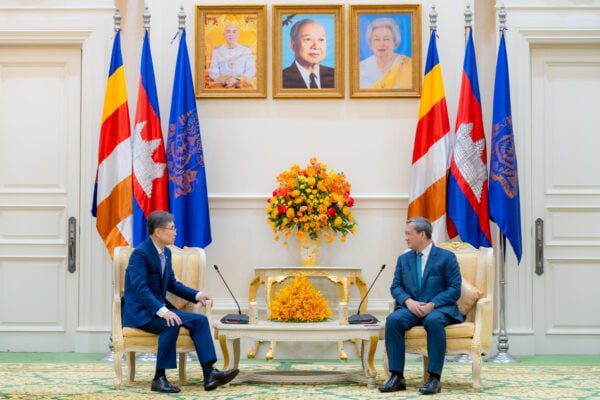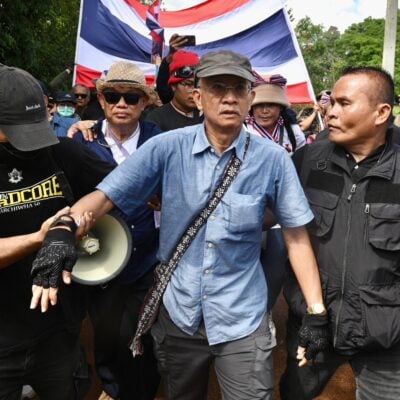

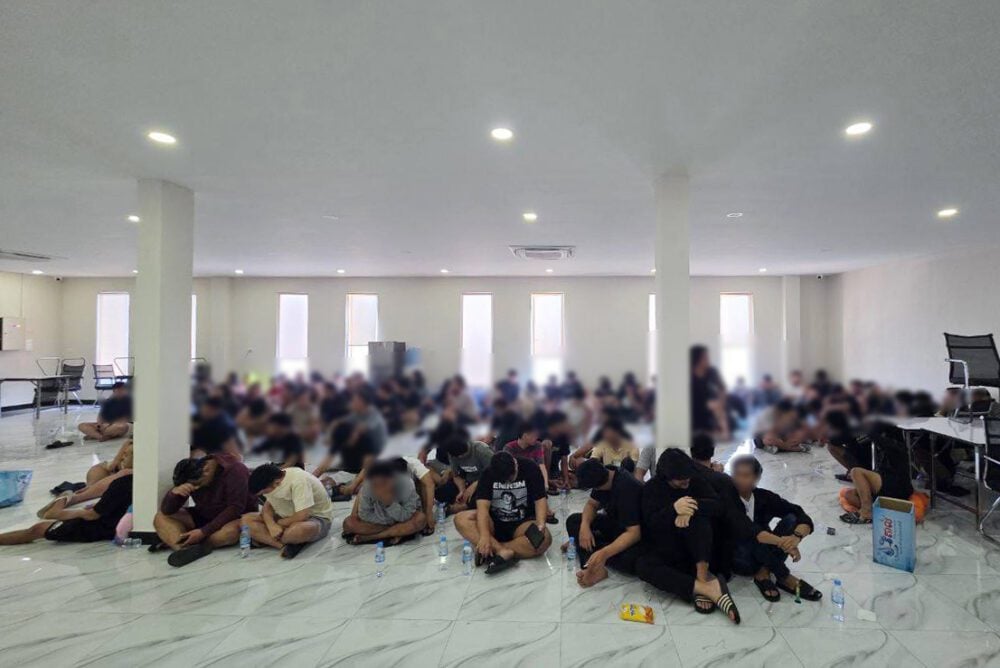
Police have raided suspected online scam centers in at least six provinces since Wednesday, following a government directive and a high-level meeting with Prime Minister Hun Manet – but major known compounds and politically connected elites remain untouched, according to a transnational crime expert and a watchdog group.
Reports have also emerged of local authorities undermining the crackdown by allegedly releasing suspects, while images from Kampong Speu appear to show suspected scammers – whether coerced or complicit remains unclear – leaving a compound ahead of a raid.
More than 1,000 foreigners have been detained so far, including more than 115 women. Most are Chinese, Vietnamese, Thai, Indonesian, Bangladeshi, Taiwanese, and Myanmar nationals, according to police reports.
The bulk of the raids took place Wednesday into the night across the provinces Kampong Speu, Pursat, Kratie, Banteay Meanchey, Preah Sihanouk and Phnom Penh.
“The fact that none of these raids have targeted the major, well-known scam compounds is exactly the point – this is a tightly orchestrated exercise designed to produce the appearance of decisive action while preserving the core industry and the interests of the involved elites,” said Jacob Sims, a visiting fellow at Harvard University’s Asia Center who studies transnational crime networks and has researched state involvement in Cambodia’s scam operations.
Industrial-scale scam centers have long proliferated across Cambodia in recent years, with estimates predating Wednesday’s raids suggesting as many as 350 active sites generating between $12 billion and $19 billion annually. The compounds rely largely on forced or coerced labor, with some 150,000 people from at least 22 countries exploited, according to Winrock International, which led the Cambodia Counter Trafficking in Persons project.
“These compounds are not obscure or hidden. Many have been documented by Amnesty International, Cyberscam Monitor, my own investigations, and others – some even previously visited by authorities without serious consequence,” Sims said. “Yet the sites owned or operated by the most powerful CPP-linked [Cambodian People’s Party] elites remain unscathed.”

A report published by Sims in May recommended indictments, sanctions, visa bans and other accountability measures for 28 government officials and businesspeople – including Prime Minister Hun Manet’s cousin, Hun To – over alleged links to or complicity in the illicit industry, triggering a wave of condemnation from officials.
Cyberscam Monitor, a regional watchdog tracking online crime networks, has identified at least 181 suspected scam sites nationwide, including six compounds near a suspected ring raided in Phnom Penh’s Toul Kork district on July 14. It also noted that major well-known compounds have yet to be targeted.
One suspected major scam site yet to face a crackdown is a compound in Takeo province known as “Mango Park 2” on scam watchdog channels. It is roughly nine kilometers from Mango Park in Kampong Speu, which was reportedly raided by national police late last year but appeared to still be operating then, with more than 1,000 potential trafficking victims unaccounted for at the time.
Reports of syndicates colluding with local authorities during the raids have also surfaced.
During an operation in Pursat province on Wednesday evening, a deputy prosecutor allegedly “released a group of online scammers,” according to government-friendly media Fresh News, which cited a leaked audio message of Hun Manet ordering action against the official.
Circulating social media posts verified by CamboJA News appear to show individuals fleeing a compound in Kampong Speu’s Kong Pisey district with their luggage just before a raid. Police later said they detained 63 people, mostly Chinese, in the operation.
Asked if those detained in the raids were screened for trafficking, a step anti-trafficking experts have formally criticized authorities for neglecting, Chou Bun Eng, Permanent Vice Chair of the National Committee to Counter Trafficking, said procedures are in place to determine whether individuals are victims, scammers, or living in Cambodia illegally.
“In the recent crackdowns, our initial screenings primarily uncovered immigration and labor law violations,” she said. “When it comes to other offenses, I firmly believe this group will not give us clear or accurate answers.”
She added that spending too much time investigating every offense would strain detention facilities and draw more criticism for human rights violations. She called for “shared responsibility” with countries of origin, urging them to take back their nationals for further questioning while Cambodia focuses on prosecuting offenders in court.
Asked about the number of scam sites operating in the country, a figure raised by Cyberscam Monitor and other investigators, Chou replied, “We are conducting investigations. How many we will actually find, we’ll see.”
Provincial police chiefs in Banteay Meanchey and Pursat, Sar Theng and Seth Lous, did not respond to requests about whether major scam compounds have been targeted, if trafficking screenings took place, or if ringleaders or compound owners have been arrested or are under investigation.
National police spokesperson Chhay Kim Khoeun also declined to comment.
For Sims, a genuine crackdown would require holding accountable senators, governors, cabinet ministers, and senior advisers close to the Prime Minister – figures he identifies as owning and protecting the major scam compounds. But he says the political realities make this unlikely, and meaningful disruption will have to come from outside Cambodia.
Drawing on his research, Sims views this week’s directive and raids as largely performative, aimed at easing international pressure while consolidating power among elites. He notes this pattern has played out before in sectors like illegal logging, where crackdowns targeted small operators but shielded well-connected interests.