Listen to the audio version of this article (generated by AI).
Human trafficking is usually found nestled together with other crimes – and the latest record-setting form of human trafficking to be seen in Cambodia is no exception.
Human trafficking, or in this precise context, the trafficking of foreign migrants for the purpose of their forced criminality, is what is fueling the unprecedented boom in online scam operations across the country. According to Winrock International’s Cambodia Counter-Traficking in Persons (CTIP) Project, in 2025 an estimated 150,000 foreign migrants have been confined in as many as 350 “closed” scamming sites run by organized crime syndicates in diverse locations from Sihanoukville, to rural Kandal and Koh Kong province, to border hubs like Bavet, Poipet and O’Smach, and Chrey Thom.
Cambodia has begun to respond to the massive online scamming industry, but efforts to address the attendant, equally massive human trafficking problem remain abjectly absent.
The prevailing international law on trafficking in persons – the U.N. Protocol to Prevent, Suppress and Punish Trafficking in Persons – was enacted 25 years ago in recognition of this crime’s unique nature, and its need to focus on the involuntary exploitation of its victims. A key provision in the Protocol and subsequent more binding compacts, such as ASEAN’s anti-Trafficking Convention, is the need to identify victims through screening efforts using globally-accepted indicators. Equally emphasized is a concomitant principle of “non-punishment” of suspected trafficking victims – such as the punishment of victims for immigration offenses committed while they were subject to trafficking.
Over twenty-five years of experience around the world using the 2000 UN Protocol has led many law enforcement agencies to respect an anti-trafficking truism: successful investigations and prosecutions cannot be achieved without adequate identification and protection for the victims of this serious human rights crime.
However, in Cambodia – which is described by U.N. agencies and international criminal justice organizations as an epicenter of the global cyber-scam industry – victims of forced online scamming are seldom identified or helped by government authorities.
Over 15,000 scam center workers reportedly have been arrested over the last two years, but the vast majority has not been screened to identify trafficking victims; as a result, they are considered violators of Cambodian immigration law and detained until deportation.
Since first acknowledging the online scamming industry’s existence in late 2022, the government has carried out sporadic law enforcement efforts aimed at closing – if only temporarily – some of the scamming centers.
One such highly publicized action was the October 2024 “raid” on the large Mango Park scamming compound on Highway number 3 at the Kampong Speu border; after a day-long presence of a large police force inspecting the premises, “1,000 foreign workers were found” but none were identified as trafficking victims.
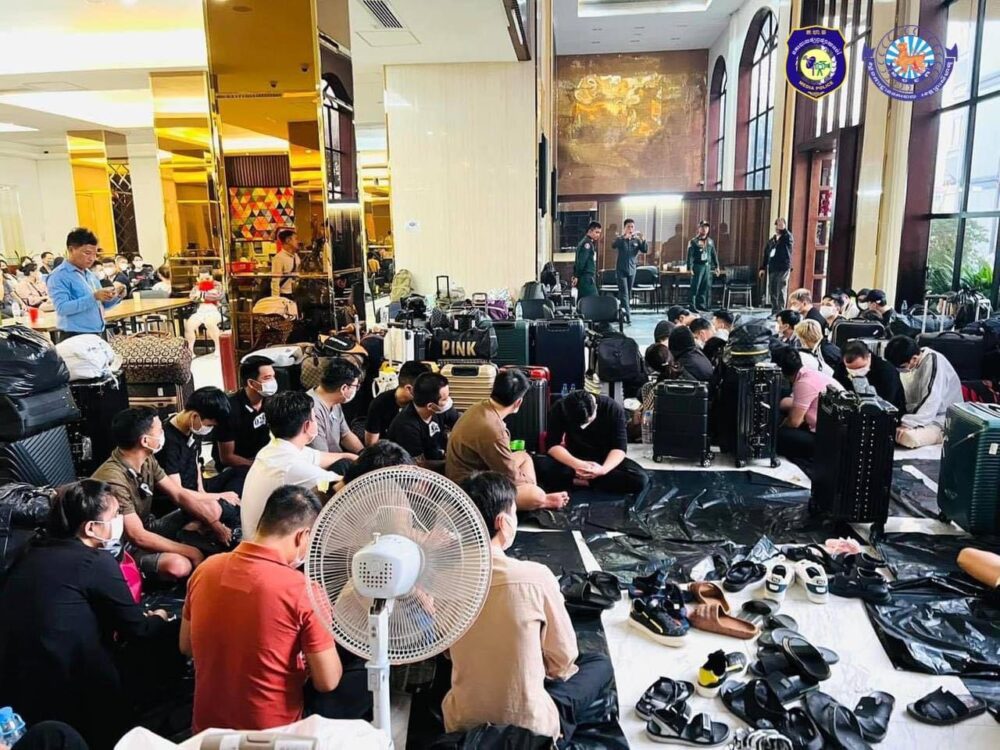
Currently, and in the wake of alleged scam boss Chen Zhi’s Jan. 6 arrest and extradition to China, and a national decree issued the same day aimed at cracking down on the residency of illegal foreign workers, the government intensified its rhetorical anti-scamming campaign, backed up with limited police actions to close or threaten to close high-visibility scam compounds. Reacting to this perceived threat, many major compounds “opened” and allowed foreign workers to leave and this led to thousands – if not tens of thousands – of suspected trafficking victims dumped onto Cambodian roads and streets.
There’s been no discernable effort by authorities to identify any of these freed foreign workers as victims of human trafficking or forced labor, and the new decree prescribing punishments for anyone providing refuge or assistance to illegal foreigners has meant that they face the additional barriers of being refused access to commercial accommodations and transportation.
When authorities in another Mekong country recently committed for a brief period to the screening of 260 foreigners extracted from scam centers in eastern Myanmar, 258 of them were assessed as human trafficking victims – a 99% rate of positive identification. Given the Cambodia scam industry’s very similar profile to that in Myanmar (some Cambodian scam centers share owners with Myanmar scam centers), it’s reasonable to assess a similarly high rate of human trafficking among Cambodian scam center workers.
The current and ongoing shuttering of some scam centers and scattering to the streets of their foreign workers addresses immigration and cyber-scam containment goals, but it fails completely to address human trafficking. Missing opportunities to investigate and prosecute cases of human trafficking, Cambodian law enforcement are also causing huge harm to thousands of victims. In this broader context, law enforcement operations to date should not be applauded as they represent a setback to the global fight against human trafficking.
It’s high time for Cambodia to address these hundreds of scam centers with an anti-trafficking response. The victims deserve it.
Note: (Mark Taylor is an international anti-trafficking consultant and former Chief of Party of Cambodia Counter-Trafficking in Persons Project)