Listen to the audio version of this article (generated by AI).
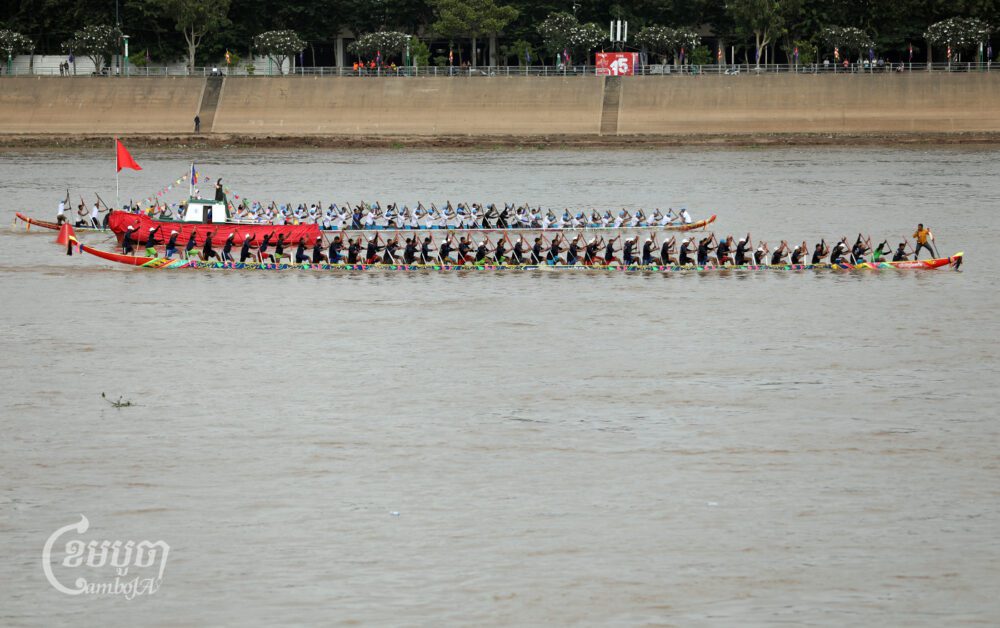
Water Festival celebrations marking the end of Cambodia’s monsoon season have been canceled in Phnom Penh for the second consecutive year, the government said on Wednesday.
The festival’s traditional boat races on the Tonle Sap River and full moon ceremonies in the capital have been canceled to prioritize efforts to resolve an ongoing border dispute with Thailand and assist thousands of residents displaced by deadly clashes with the neighboring country last year, according to a directive shared by Prime Minister Hun Manet on Facebook.
The cancellation does not affect celebrations in other provinces. Phnom Penh’s Water Festival celebrations were also canceled last year following the first round of border clashes with Thailand, although Khmer New Year festivities went ahead earlier this year.
Civil servants will still receive the Nov. 23-25 public holiday, but government working groups involved in border-related operations, including assistance for displaced residents, returning migrant workers and military personnel, were instructed to continue their duties.
The directive also instructed ministries and local authorities to use the holiday period to help returning migrants find employment, promote local economic activity, prepare for natural disasters and maintain public security.
It was not immediately clear whether the decision was also intended to preserve government funds for communities affected by last year’s border clashes.
For some of those displaced by the conflict, the cancellation reflected the continuing hardships facing communities still unable to return home.
Voeun Phallin, 40, a displaced resident living in government-built housing in Banteay Meanchey province after losing her home behind Thai barricades last year, called the decision appropriate.
“I think it’s the right decision because our country has not yet fully returned to peace,” she said. “I do miss the Water Festival, but our suffering cannot simply be set aside.”
Phallin said she was still adjusting to life after losing her home and does not feel ready to celebrate the holiday.
She also cited a lack of access to clean water, saying residents must purchase water for daily use, and urged the government to create jobs near relocation sites.
“I hope factories can be built in this area so that I and others can find work because existing workplaces are too far away,” she said.
More than 21,000 Cambodians from border provinces remain displaced or living in temporary housing after their villages along the border were occupied by Thai forces, according to the Interior Ministry. Bangkok says the areas are part of Thai territory or frozen frontlines following a ceasefire reached in December.
Despite the government’s assertion that it has secured employment for tens of thousands of returnees, many displaced residents and migrant workers returning from Thailand continue to report limited job opportunities and difficult living conditions.
Labor Ministry spokesperson Sun Mesa did not immediately respond to a request for comment.
Independent political analyst Meas Nee said it was difficult to assess the government’s decision to cancel Water Festival celebrations in Phnom Penh after allowing Khmer New Year celebrations to proceed earlier this year despite the lingering effects of the border conflict.
“We can only question the consistency,” he said. “If the government has a clear reason that the country is facing a border crisis, that the situation has not yet been resolved, and that it is therefore not appropriate to celebrate, then that is a reasonable justification for the government.”
He said he hoped the government would resume Water Festival celebrations in the capital next year, expressing concern that repeated cancellations could send an unfavorable signal about preserving Cambodia’s cultural traditions.
Since 2010, Cambodia has canceled Water Festival celebrations in Phnom Penh nine times, citing natural disasters, public health emergencies, national and international political developments, and border-related issues.