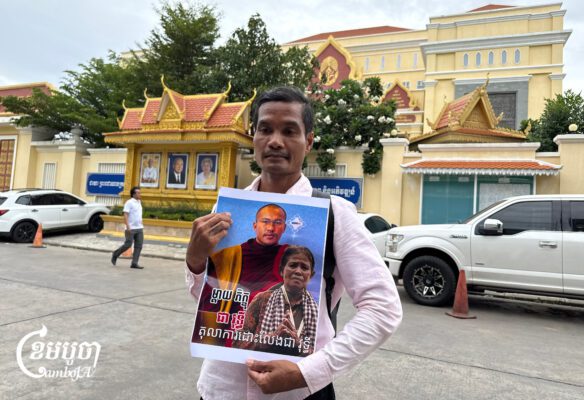
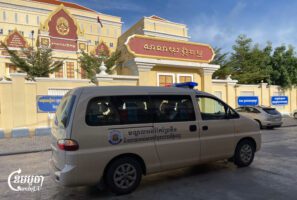
A group of villagers burned down the Srae Chrey sub-ranger station in Lumphat Wildlife Sanctuary in Ratanakiri province on September 6 after a 19-year-old Indigenous woman died near a gold-mining site. Environmental officers were blamed by the villagers for allegedly “frightening” her, but authorities denied any link between her death and their intervention.
The villagers said on the incident day, the officers had arrived at the site where they were mining for gold using traditional, small-scale methods, and proceeded to crack down on the activity.
According to the villagers, Salieng Savin, 19, an Indigenous Bunong woman from Roya village in Koh Nhek district, Mondulkiri province, suffered a cardiac arrest as a result.
In a short video recorded before the environmental station was razed, villagers said environmental officers allegedly ran after villagers in an attempt to arrest them, which caused Salieng to panic.
“Environmental officials showed no compassion for poor villagers. People are hungry. We are not clearing land; we are only digging shallow areas [for gold] to earn a little money. We ask the authorities to find a solution for us,” several villagers said in the video.
The victim’s family said she died of a cardiac arrest after becoming frightened and fell off her motorcycle near the mining site, denying talks that she died in a traffic accident.
However, the family could not provide further immediate details to CamboJA News because they were in the midst of the funeral ceremony and telephone connection in the area where they live is poor.
According to a press release by Ratanakkiri Provincial Department of Environment, their park rangers on September 6 “advised” a group of illegal gold miners inside the Lumphat Wildlife Sanctuary to cease their mining activities peacefully. “About two hours later, at 1.15 pm, the [department] received information from the police station at Roya commune that there had been a motorcycle accident that had resulted in the death of a person,” the release stated.
The department dismissed the villagers’ claims that Salieng’s death was linked to the rangers’ intervention, saying that the incident was used to “fuel accusations” that led to the destruction and burning of a deputy park ranger’s station.
The department condemned the incident and villagers’ claims, describing it as “defamation, incitement, violence and destruction of public property”.
“This incident was taken advantage of by the people who accused the park rangers and incited them to cause trouble, leading to the destruction and burning of the deputy park ranger’s office,” the department said.
According to Toul Laob, 41, a Bunong Indigenous man from Roya village in Koh Nhek district, villagers were mining for gold at a “small, family-based scale only” and “not operating a large-scale commercial mining operation” in the area.
He said the mining sites were located near villages and residents’ rotational farms. The income earned from mining supplemented their livelihoods after harvest.
Laob recalled that on the day of the incident, villagers were carrying out their usual mining activities when three environmental officials and a volunteer allegedly appeared at the site to “crack down on their activity”.
“We ask the authorities to consider the needs of people who are struggling. We do traditional mining only to earn a little money to send our children to school,” he said.
Another Bunong villager, Sreum Chouch, 41, who is member of the Roya community committee, said villagers became angry when they went to the office to discuss the incident and seek a solution but found no one at the station.
While he did not support the use of violence to resolve the dispute, which should have been handled through legal channels, Chouch said the environmental officials’ actions were “inappropriate”.
He urged authorities to act transparently and conduct a thorough investigation of the incident.
“We cannot accept some of the actions of the technical officers. Sometimes they act outside their professional duties. But I also do not support the use of violence to burn down a government station,” he said.
“We cannot accept the way Indigenous people are treated. Minerals are common resources. Villagers do this [mining] only to survive, while investment companies can destroy entire mountains without facing legal action,” Chouch alleged.
Sei Touch, governor of Koh Nhek district, told CamboJA News that authorities have already identified those suspected of burning the government building.
He said the authorities would conduct an investigation to determine Salieng’s cause of death after the funeral. “This is not a small matter because someone has died.”
Touch said Salieng’s husband told authorities that she had a heart condition and suffered “severe fear and stress”.
He mentioned that she did not die in a traffic accident because the incident occurred inside the forest rather than on a public road.
“We are giving the family time to hold the funeral first. The police will conduct the investigation afterwards. If we proceed now, it could create more problems for the authorities and technical officials. We have already investigated and identified the suspects,” he said.
On the same day of the incident, provincial environment departments in Kratie and Mondulkiri issued statements condemning the villagers’ action, calling it an “illegal act” involving a gathering of people to destroy public infrastructure.
Din Khorny, Ratanakiri provincial coordinator of rights group Adhoc, said a joint investigation by experts is needed to establish the facts and ensure justice for all parties.
He said “conflicting accounts” are common when disputes arise. Environmental officials said the victim died in a traffic accident, while residents claim she died of a heart attack and fell off her motorcycle when environmental officers chased them.
“If it is a traffic accident caused by the other party, is that illegal or not? In the case of an environmental officer, is he performing his duty correctly? And is it necessary to chase citizens until they have a heart attack and die?” Khorny said.
Without a joint investigation, questions about responsibility and accountability might remain unresolved, leaving one side feeling that justice failed.
In August 2023, a similar incident occurred when over 300 Kraol Indigenous villagers in Srae Chis commune in Kratie, torched an Environment Ministry station after years of tense relations with the officers. The protest was triggered following reports of the Sor Sor Sdom Sat Tao protected area being expanded by 4,500 hectares. No arrests were made at the time.