Listen to the audio version of this article (generated by AI).
A new research, which examined three major Chinese investment projects in Cambodia, found “significant compliance gaps” in Responsible Business Conduct (RBC) international standards causing severe impacts on the environment and community livelihoods although they adhered to minimum national laws.
The preliminary findings from the projects: Lower Sesan 2 hydropower dam, Dara Sakor Special Economic Zone (SEZ) and Funan Techo Canal were presented at a consultative workshop organized by the NGO Forum on Cambodia (NGOF) on July 24, 2026.
The workshop, done in collaboration with Give to Nature and supported by Porticus, aimed to review Environmental and Social Impact Assessment (ESIA) methodologies and promote the development of an Environmental, Social, and Governance (ESG) guidelines manual for sustainable investment.
The evaluation was conducted based on RBC standards, and national legal frameworks and international standards—International Financial Corporation, UN Guiding Principles, and the OECD (Organisation for Economic Cooperation and Development).
While most Chinese investment projects fulfilled Cambodia’s minimum legal requirements, such as the Law on Investment, Land Law, and the Environmental Code, the evaluation assessed using RBC standards showed “severe shortcomings”.
Key deficiencies include limited public consultation, weak law enforcement mechanisms, and redress for grievances along with inadequate livelihood restoration systems for affected people.
About 60 participants participated in the workshop, including representatives from government institutions, the private sector, civil society organizations, development partners, and affected communities.
China is Cambodia’s largest investor, trading partner and donor, accounting for up to 54% of investment capital in 2025, said project researcher Sam Chanthy, noting that a surge in foreign investment was driven by major projects, such as the Dara Sakor SEZ and Funan Techo Canal.
At the national level, these mega projects are viewed as transformational forces reshaping Cambodia’s profile, acting as catalysts for economic development through power generation, industrial zone development, transport infrastructure expansion, and creation of jobs.

However, the study documented growing tension and negative impacts from the perspective of local governance and actual living conditions of residents. The impacts were divided into environmental and social impacts.
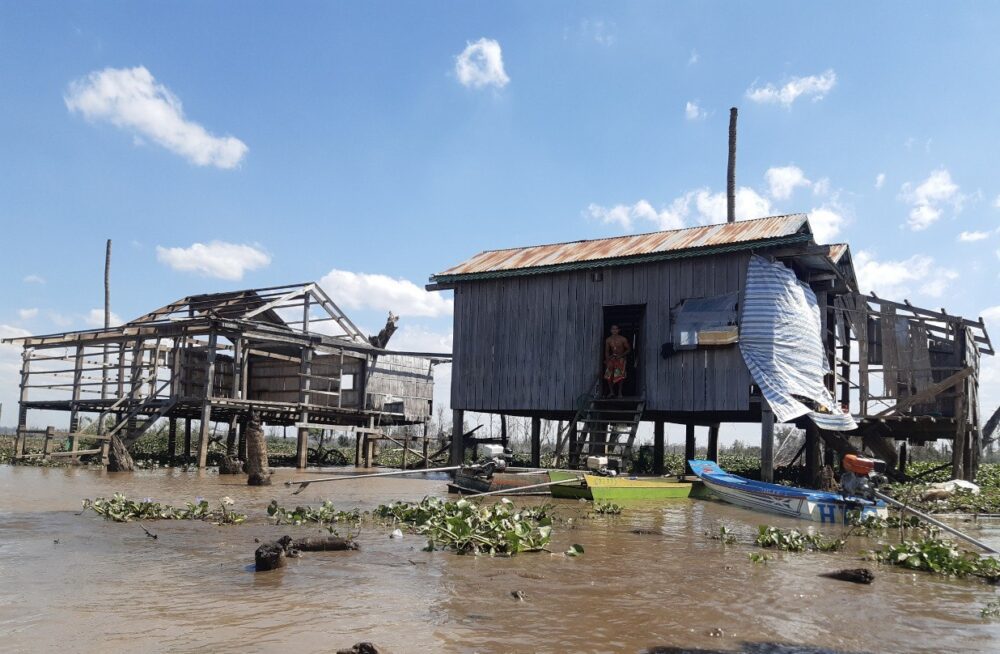
Almost all environmental degradation began with deforestation, leading to a loss of biodiversity. Major infrastructure building, such as the Lower Sesan 2 dam and Funan Techo Canal, altered hydrological systems and water resources, disrupting entire ecosystems and reducing land productivity.
Evidence from consultations with authorities and communities revealed that the environmental issues were not temporary, but “chronic” problems that need to be monitored throughout the project lifecycle.
As for social impacts, resettlement was identified as a long-term challenge. The findings indicate that the process of community displacement is managed primarily through a “top-down” approach. Local actors and provincial authorities were said to have limited decision-making influence, serving alongside local communities primarily as “mere implementers of relocation directives”.
According to the report, the hydropower dam and Dara Sakor SEZ projects involved relocating hundreds of families to new sites situated several kilometers away, while the Funan Techo Canal project involved partial relocations.
Resettlement caused affected households to experience immediate loss of access to natural resources, severely impacting livelihood and increased financial burden.
The report noted that “a one-off compensation payment cannot replace lost long-term survival capabilities”. While authorities view physical achievements positively, such as new housing, roads, and electrical grids, many citizens cannot restore their financial stability with the loss of daily income source from the river or sea.
Compensated, only ‘moderately satisfied’
The study used a mixed-method data collection approach, surveying 237 households to analyse the impact and compensation. Additionally, five focus group discussions were organized, and key informant interviews with 16 individuals at the local level (commune chiefs, district governors, and provincial department representatives) and five individuals at the national level. Direct on-site observations of land use and environmental changes were also conducted in each location.
At the dam project in Stung Treng, project implementation required the resettlement of 1,025 families (equivalent to 4,620 people) from seven villages in four communes in Sesan District.
The compensation package featured a house, residential land (20 × 50 meters), agricultural land (three to five hectares), compensation for lost property and damaged crops, transportation service, and six months of livelihood restoration support. The survey on satisfaction level showed that 46% of residents reported moderate satisfaction, 26% high satisfaction, 6% very high satisfaction, and 6% low satisfaction.
The livelihoods of residents have changed significantly. Households with “good” standard of living dropped from 45% (before the project) to 28%, while households with a “moderate” standard of living increased from 39% to 42%.
At Dara Sakor in Koh Kong province, the SEZ project saw the relocation of over 1,000 households from Koh Sdach and Tanoun communes in Botum Sakor and Kiri Sakor districts. Residents received housing, residential land (0.5 hectares in size), agricultural land (two to three hectares of land for families of four or more members), and compensation for property and crop losses.
The survey showed that 40% of residents were moderately satisfied with the compensation package, while 31% (highly satisfied), 23% (low), 3% (very high), and 3% (not satisfied). Their overall standard of living remains uncertain.
The Funan Techo Canal project, which would run through Takeo, Kandal, Kampot, and Kep provinces, affected 2,305 households (equivalent to 11,525 people) across a residential area of 180 hectares, with 400 households being fully impacted. The form of compensation is cash payouts for damages (data compiled and compensation for farmland disbursed in phases).
Regarding satisfaction levels of the compensation, 39% said they were highly satisfied, 36% (moderate), 15% (slightly satisfied), 9% (very high), and 1% (completely dissatisfied). In addition, 47% of the people asked said they “strongly supported” the project.
‘We’re allowing them to earn a living first’
Resident Lim Tong Eng, who is affected by the Funan Techo Canal project in Samraong Thom Commune, Kien Svay District in Kandal, said that even after a year, he has not received any information regarding compensation.
Living in a state of uncertainty has impacted his livelihood as he does not dare to cultivate long-term crops like mango and coconut, relying instead on limited short-term crops, such as chili and banana.
“This uncertainty is making things difficult because I don’t dare to do anything. I want to plant big crops but that takes a bit of time and I don’t dare to do it. I can only plant quick-yielding crops with faster yields,” the 77-year-old told CamboJA News.
Personally, he said, he does not want the project to take place, but cannot say much because it is a government project.
“In my heart, I don’t want them to dig [the ground]. I don’t want the project because it affects our land and home. Nothing is left at all. The impact for me is 100%; land stretching from my house to the farmland used for cultivation. But if the government wants it, what can I do? That’s just how it is.”
Heng Sothy, director-general of the General Department of Waterway, Maritime Transport and Ports under the Public Works and Transport Ministry, said some residents affected by the canal project received compensation.
Property measurements have been completed and a three-tier compensation strategy aligned with construction phases is being put in place to compensate mildly affected groups (farmland) first. It allows moderately-affected groups in urban areas to continue using their land and running their business to prevent income loss, while preparations are being made to resolve “heavily-affected” groups progressively in subsequent phases.
“Construction has not started in specific locations yet, so why would the government take their land right away? The government is allowing them to continue earning a living, and secondly, it gives them time to find suitable relocation sites. This is the Royal Government’s strategy.”
Regarding the level of satisfaction, he said: “I don’t know the exact data collection or methodologies used. Sometimes, meeting a group of opponents or a group of dissatisfied people can make the rate of dissatisfaction appear high, but overall and from a macro perspective, we see that the majority of citizens are satisfied.”
However, during the consultative workshop to gather input from stakeholders that day, officials from the Ministry of Environment also requested a review of the index classifications and suggested submitting the preliminary findings to them for review.
Drawing in experience to move forward
A participant at the consultative workshop, Prak Pheung, an indigenous Punong working at the Cambodia Indigenous Women Association, called for the report to show the impacts of resettled indigenous people of the practice of traditional customs and traditions, and lack of access to adequate clean water. Nearly 100 affected families in the Kbal Romeas area have not accepted compensation yet, she said.
Project researcher Sun Chanthy said the findings are based on existing documents and evidence, adding that he faced difficulties accessing or obtaining information for verification, such as reports relating to the evaluation of government-led investment projects.
In turn, he urged investors to share evaluation reports so that they can examine transparently, rather than keeping them secret, which impacts or limits assessment and outcomes.
Chanthy mentioned that he did not emphasize the positive aspects of the projects in the report as “most of the points raised are areas that need to be understood along with experienced impacts”.
“This report has no intention to disparage investment, rather it serves to draw on experiences to move forward, meaning we should think carefully in order to prevent adverse impacts, ensure sustainable investment, and minimize risks from future investments.”