Listen to the audio version of this article (generated by AI).
Thousands of foreign nationals suspected of working in scam centers in Cambodia and seen as potential trafficking victims have been detained or deported since the start of the year, the Ministry of Interior said Thursday.
The nationwide enforcement drive, which the government says will shift to “eliminating” scam networks by April, broadened in January after mounting international pressure on Cambodia and the extradition to China of alleged scam kingpin Chen Zhi, a former adviser to the prime minister.
The campaign has triggered a preemptive exodus from long-suspected scam hubs that observers describe as a humanitarian crisis, with many seeking help at the Chinese and Indonesian embassies before being sent to holding centers on the outskirts of Phnom Penh.
Analysts and anti-trafficking specialists have urged investigations of politically connected elites linked to the scam industry and called for thorough screening of those rounded up in raids, citing the networks’ documented reliance on forced or coerced labor.
A transnational crime researcher also questioned the durability of what may be the most expansive enforcement campaign to date and whether the illicit industry will be fully dismantled.
Interior Ministry spokesperson Touch Sokhak said that from Jan. 1 to Feb. 4 authorities deported 845 people linked to online scams, including 194 women from 14 countries, in coordination with embassies. He said authorities are preparing to deport another 596 individuals once legal procedures are completed, without specifying their nationalities.
He said Cambodia “deported” more than 5,500 people connected to online scams last year and that most were victims rather than perpetrators. He added that roughly 90% of those rounded up since January have also been found to be victims rather than willing participants.
The ministry’s messaging marks a shift from earlier statements that downplayed the number of forced scam workers during past raids critics said were performative, as compounds often appeared operational afterward and trafficking screening was seen as patchy.
Anti-trafficking specialists have been outspoken this year, urging authorities to take proper steps to protect people trafficked into scam compounds as raids expanded.
Mark Taylor, an international anti-trafficking consultant and former chief of party for the Cambodia Counter-Trafficking in Persons Project, noted the distinction between forced deportations for identified trafficking victims and voluntary repatriation under U.N. protocols ratified by Cambodia.
“Victims are to be repatriated voluntarily and offered the opportunity to participate in an investigation against trafficking offenders,” he said. They are also to be provided protections such as counseling, shelter, medical care and legal aid.
A 2023 report by the UN human rights office estimated that at least 120,000 people in Myanmar and 100,000 in Cambodia had been forced to work in online scam operations in the region that year, networks that reportedly swindled $18 billion to $37 billion from victims worldwide.
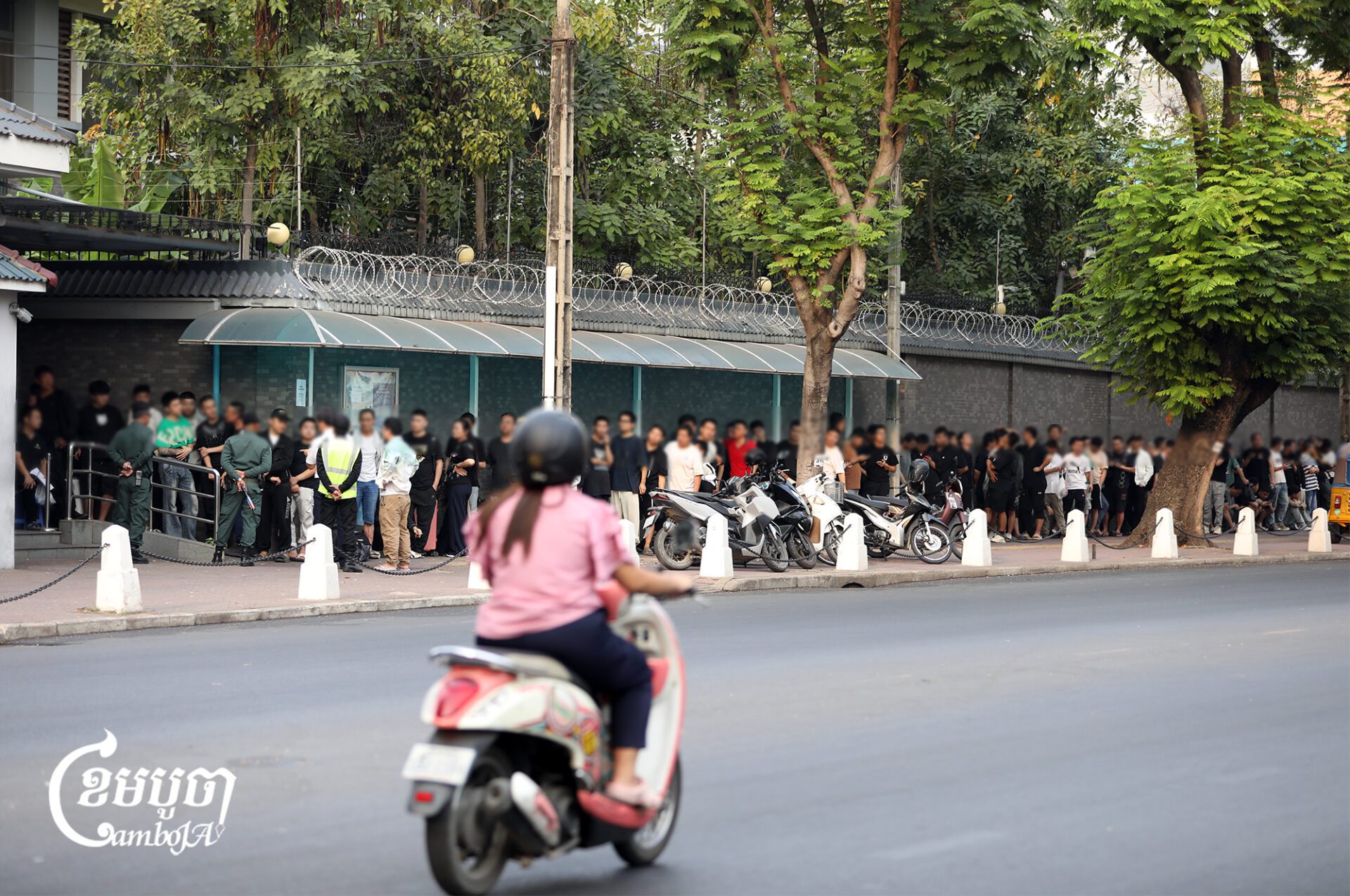
Recent operations have also swept up more foreigners, including last week at an alleged scam compound in Svay Rieng province’s Bavet city, where police detained more than 2,000 people in a raid that reportedly involved officers firing warning shots.
The enforcement wave is seen by observers as more significant than past crackdowns, but caution remains.
Jacob Sims, a visiting fellow at Harvard University’s Asia Center and a transnational crime analyst, said while disruption of scam networks appears real, its durability is uncertain. He said lasting change still requires meaningful elite accountability and proper protection of trafficking victims and evidence.
“These deficiencies make the response look more like a cover-up than a sustainable and effective effort to stamp out the industry,” Sims said, warning that without elite accountability and credible protections for victims and witnesses, scam networks are likely to reemerge once political and international pressure eases.
Aside from the high-profile arrest of politically connected tycoon and alleged scam operator Li Kuong, following the arrest of Chen Zhi, several sanctioned elites with alleged ties to scams have so far escaped scrutiny in the nationwide campagin the government has named “Operation XXL.”
On Monday, the Thai military said it had recovered a trove of evidence of transnational fraud from a scam complex in Cambodia’s O’Smach, seized during clashes last year along the disputed border. The site includes Cambodian Senator Ly Yong Phat’s O’Smach Resort, which the U.S. said runs scams after sanctioning Phat in 2024.
Phnom Penh condemned the sanctions at the time and has also denounced the Thai seizure, citing territorial encroachment.
Cambodian independent political analyst Seng Vanly also called for investigations into blacklisted high-ranking figures, saying enforcement must be comprehensive and equal in scope to restore the country’s international credibility and investor confidence.
With the government targeting April to eradicate scam networks, international pressure remains.
Over the past two weeks, Cambodian authorities have met with law enforcement counterparts from countries most affected by scam syndicates, including the U.S. and China.
(Additional reporting by Kuch Sikol)
*This article was updated at 4:20 p.m. to include comments from anti-trafficking expert Mark Taylor.