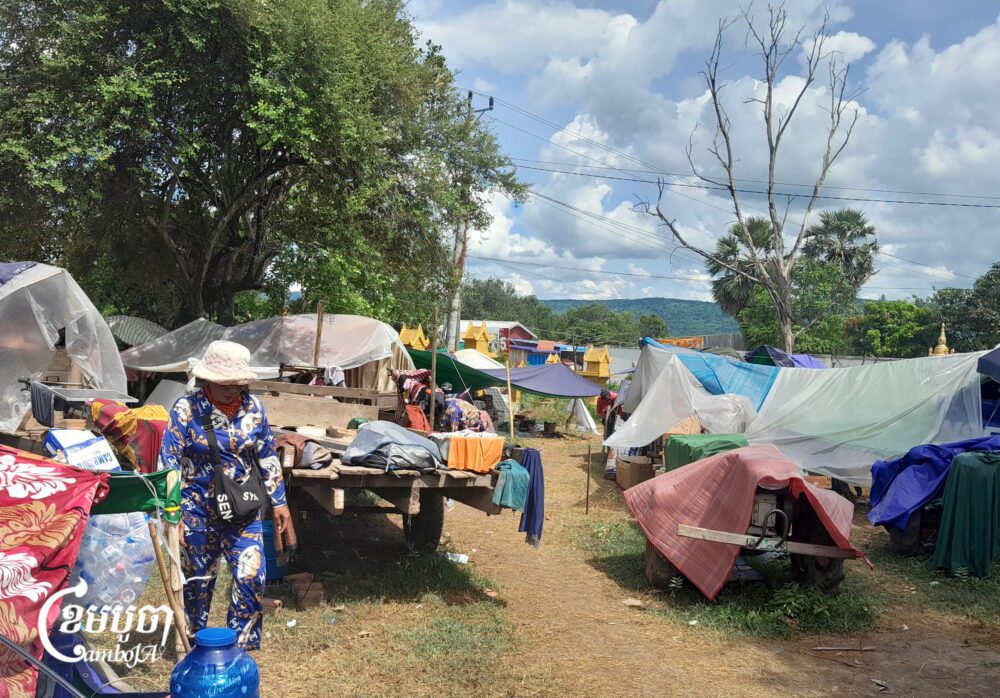
Preah Vihear province: Having experienced difficulties living in a camp lacking toilets, electricity, sleeping places and fresh food, displaced families of the conflict are hoping for lasting peace and to be able to return to their homes soon, following the signing of a 13-point ceasefire agreement between Cambodia and Thailand on Thursday.
Although they received enough food such as rice, fish, soy sauce, sausages, dried fish, other household items, and some money, the displaced people cannot wait to go home because they have not been able to earn an income, and their children cannot go to school.
Lon Liam, 48, who is among tens of thousands of displaced people who fled their homes after the five-day Cambodian-Thai conflict erupted on July 24, said the camp is safe and they received money and provisions, but she still has to spend her own money to buy fresh food for her grandchildren.
Liam fled with nine of her family members from Char village in Kantuot commune, Choam Ksant district on July 25, to Wat Oddarkiri Tuol Andet Safe Center in Thnal Baek Village in Thmei Commune, Kulen District, leaving her husband behind to look after their pigs, chickens, and ducks.
“I don’t want it [conflict] to happen, I just want to go home soon. My daughter is pregnant, so it’s hard to stay. I just want to go home. When the war is over, I will go home.”
Sitting on the piece of cardboard while talking to CamboJA News, she said she has been sleeping on cardboard every night and does not get much sleep, especially when it rains. In addition, the bathroom is “far away”, about 50 meters, and she has to wait 30 minutes because many people want to use it every morning.
“Sleeping on the ground; how can I sleep? The same with my children; how can we sleep? Only my pregnant daughter can sleep on the cart behind a two-wheel tractor.
“If it rains, I run to sleep with my pregnant daughter on the cart. Some of us sit, some sleep. It’s hard, very hard. I pray that the conflict will end and I can go home. It’s too much. It’s hard to sleep, hard to go to the bathroom, and hard for pregnant women.”
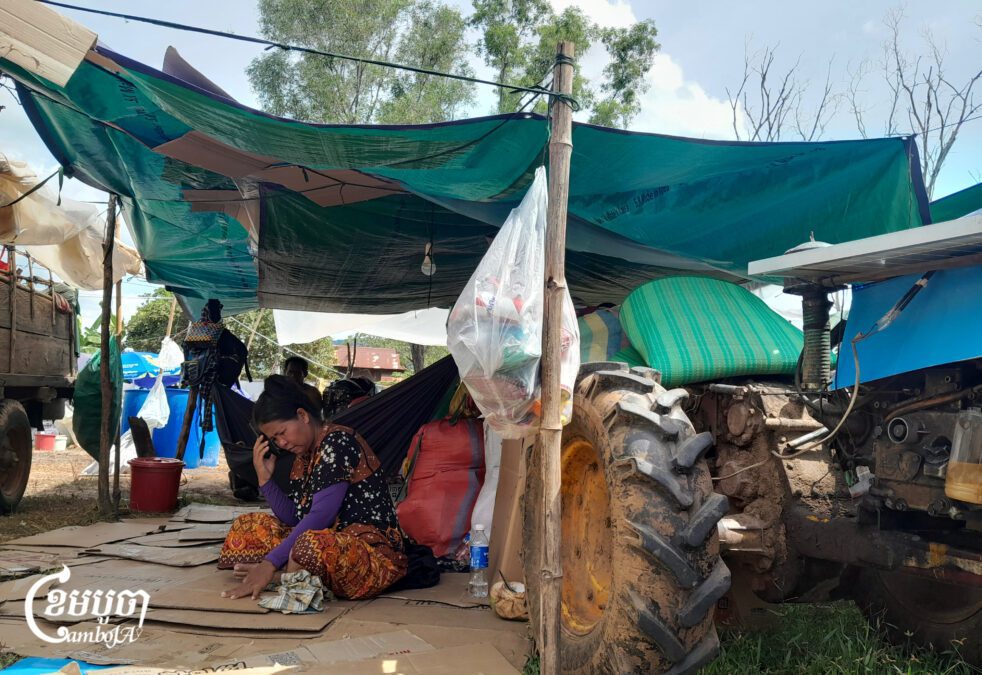
The 48-year-old woman recalled the Cambodian civil war, when she fled to hide in canals or streams, and did not receive any assistance like now, she said, sharing that she is at the camp with her children and six grandchildren, aged five to 10.
She received news from the authorities, who called for a public meeting on Tuesday, that they would set up schools soon for the children to study.
The conflict caused over 150,000 students to be without access to lessons as schools in the affected areas remained shut. A ceasefire was put in place on the midnight of July 28, but skirmishes and incursions by Thailand were reported after that.
On August 7, both parties agreed to a 13-point agreement, including a ceasefire and the use of any kind of weapons, attacks on civilians, and to avoid unprovoked firing at each other’s troops.
The extraordinary meeting of the Cambodia-Thailand General Border Committee (GBC) was also held in Malaysia, with representatives from Malaysia, the U.S., and China participating as observers.
Cambodia and Thailand expanded terms to their ceasefire, including a ban on new troop movements or reinforcements, protections for civilians, stronger communication and the immediate return of captured soldiers with hostilities halted.
An ASEAN observer team led by Malaysia will now monitor the ceasefire, while national observer teams coordinated with Malaysian defense attaches will operate independently in each country.
Both agreed that the terms “must not be violated under any circumstances”.
Back in Preah Vihear, Liam said she goes to the market every two days to buy fresh food for her grandchildren because they seldom ate the food given by the donors. Her family also receives some money from the donors.
Liam, who owes the bank 15 million riel, asked financial institutions to allow continued delay in repayment for her and other displaced people because they are still unable to earn a living.
Tham Makara, 17, who just gave birth a month ago, said she is not able to produce adequate breast milk as she traveled six hours from her home on a walking tractor, which has caused her body to ache, along with cramps and blood clots.
“It’s been a month since I gave birth, and I still feel pain all over my body.”
She also said that living without electricity and a fan at night was difficult, and hopes to return home soon.
“If there is electricity, I could buy a fan for myself because it is difficult to sleep at night as it is hot and dark,” she said.
Another displaced person, Lao Chamroeun, from Rumdaoh Srae village, Rumdaoh Srae Commun, Choam Ksant district, said this is the first time she encountered such a situation in her life.
The 40-year-old farmer is currently staying at Wat Pou Keo Meanchey, Pou commune, Tbeng Meanchey district, which housed 410 families.
She hopes for peace as she was worried about her husband, who stayed back to look after their livestock. Her husband forbade her from returning, fearing the effects of the “toxic smoke” released by Thai fighter jets.
She returned home after the ceasefire on July 28 as felt sorry for her husband, staying there from July 31 and August 2, but the village head told the people to leave because the Thais had attacked an area in An Ses. She was also worried about the effects of the toxic air.
“I was afraid of being poisoned, so I ran [back to the camp again] because there was intense shelling. Some people, including a soldier, suffered the effects of the smoke. The doctor said they had respiratory problems.
“When I saw [the situation] was quiet, I asked my husband [what was happening there]. He said they [Thai army] didn’t shoot, but he was afraid of the poison [noxious gas],” Chamroeun said, adding that he told her not to return.
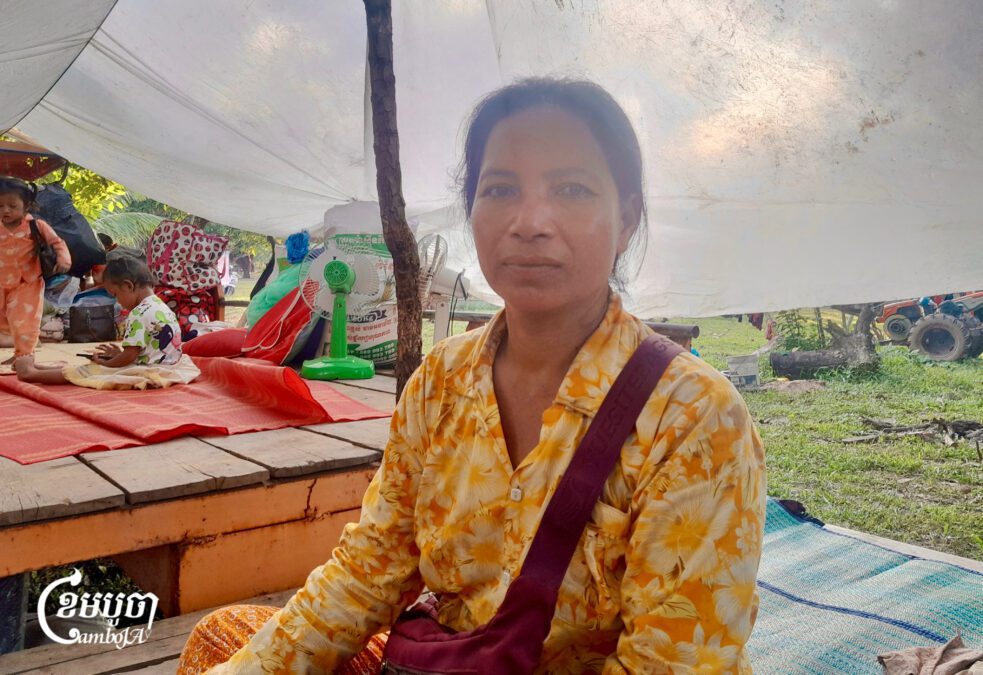
The Transcultural Psychosocial Organization (TPO) collaborated with Plan International to open its temporary branch at Wat Oddarkiri Tuol Andet Safe Center in Thnal Baek Village, Thmei Commune in Kulen District, home to approximately 3,000 displaced people, to provide education and mental health support to women, men, or children facing these issues while fleeing war.
Phan Chan Veasna, a psychologist with TPO, said the conflict and displacements contributed to stress that could lead to mental health problems if left untreated.
TPO opened temporary offices in Wat Oddarkiri, and in Oddar Meanchey province to provide mental health education and psychological support to individuals and groups who are feeling stressed.
Phan said 200 children in Wat Oddarkiri were encouraged to draw, paint, play ball and badminton. Some women with families, who are frontline soldiers, and 18 refugee women in the camp also learned about mental health education.
“By observing and listening to the children who were with their parents, we noticed that they seemed to be feeling stressed and irritable. Many of them [parents] thanked us for providing a place for the children to play,” she said, adding that the parents were relieved not to deal with their children for that moment.
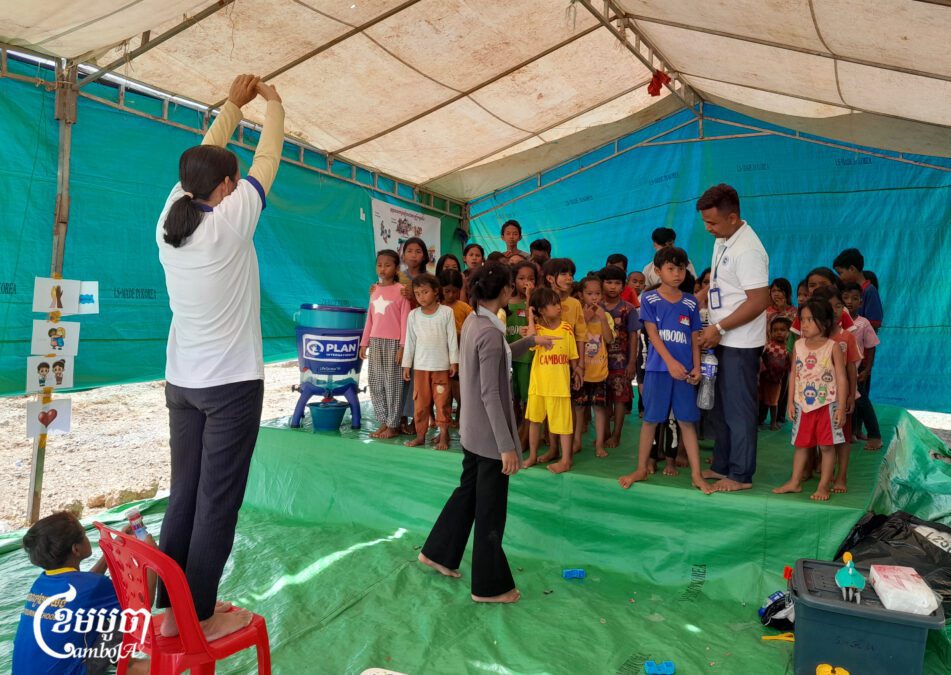
Deputy governor of Preah Vihear province Min Sitha told CamboJA News that the first step is to ensure that people have enough food to eat. His administration is paying attention to this issue and also building 10 more bathrooms from six previously. They plan to set up 20 more bathrooms with the help of philanthropists at Wat Oddarkiri.
“It’s not enough, but we can live under these circumstances. It’s not like we’re in our own homes,” he said at the temporary shelter, adding that there are 19 refugee camps, housing 30,000 to 40,000 people, most of whom fled from Choam Ksant district, the most affected district.
Sitha claimed that now the entire Choam Ksant district is filled with “toxic air” due to the chemical fumes released by the Thai military.
He said it is still not possible to set a time frame for the residents to return to their homes because some of the cluster bombs used by Thailand have not exploded, while the chemical might be lingering, affecting water, vegetables and fish. In addition, the infrastructure, houses, schools, temples, and pagodas have been severely damaged.
“If the citizens of Choam Ksant district return home, particularly farmers might be exposed to live bombs, if they go into the fields, endangering their lives. The chemical fumes in the air might be toxic, so consuming water and food might be harmful. The district is still filled with toxic air, so we cannot enter the village without a mask.”
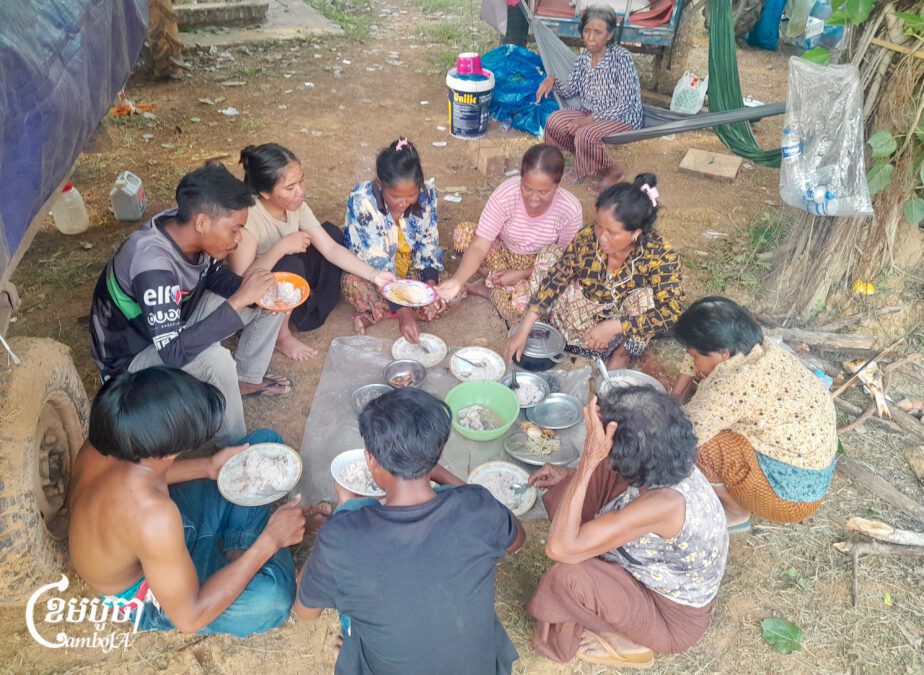
As of August 2, a total of 9,680 families or 31,904 people had fled to shelters or their relatives’ homes, Preah Vihear governor Kim Rithy wrote on his Facebook.
Residents from seven out of eight communes in Choam Ksant district amounting to 13,160 families or 34,336 people were evacuated. Wat Oddarkiri Tuol Andet center housed 1,000 families or 3,104 people.
While the governor is waiting for the right time for the people to return home safely, he also ordered the local authorities to be frugal and store reserve food for people, so that it can be delivered when they return home.
He added that the government is ready to help people along the border and in villages to build houses, wells, schools and health centers.
As of August 4, the total number of displaced people reached 124,940, according to the Ministry of National Defense. The breakdown showed 34,027 in Oddar Meanchey, 42,016 (Preah Vihear), 39,486 (Siem Reap), 8,505 (Banteay Meanchey) and 906 (Pursat).