Logistics firms and analysts are warning of trade snags and economic disruption in border towns after Thai authorities slashed operating hours at key land border crossings with Cambodia, citing security concerns.
Tensions have simmered since a May 28 border skirmish that left a Cambodian soldier dead. While both sides have called for diplomacy, Thailand late Saturday scaled back hours at several crossings.
The move followed a buildup of troops on both sides of the border, and Cambodia’s announcement that it would take the temple dispute – along with three other contested heritage sites – to the International Court of Justice (ICJ), which ruled in its favor in 1962 and again in 2013. Thai officials called the move escalatory and said they do not recognize the court’s jurisdiction.
Prime Minister Hun Manet on Tuesday set up a committee to prepare documents for Cambodia’s ICJ filing.
Both governments have agreed to convene the Joint Boundary Committee, a longstanding mechanism for resolving border disputes, in Phnom Penh on June 14.
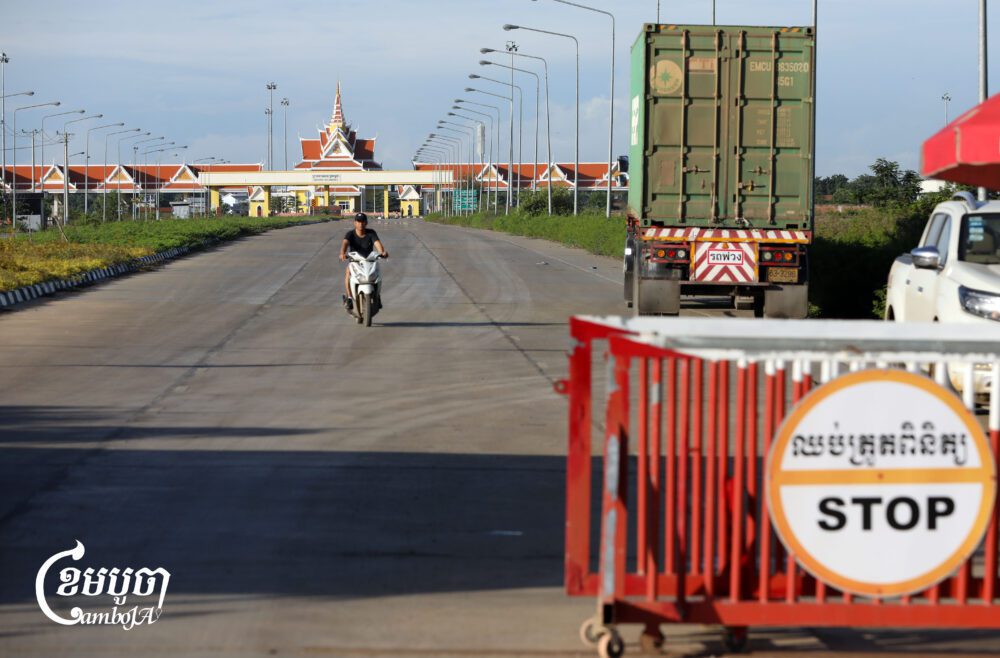
Thailand operates 17 official crossings with Cambodia across seven provinces along their 817-km (508-mile) border. Ten have seen sharp cuts to operating hours and days open.
The O’Smach and Choam international crossings in Oddar Meanchey province are now open just three days a week, from 8 a.m. to 3 p.m. Chubkakir checkpoint, also in Oddar Meanchey, is limited to the same three days but only from 10 a.m. to noon. Poipet’s main crossing, which handles most of the countries’ land trade, has seen hours cut to 9 a.m. to 4 p.m., while Cham Yeam crossing in Koh Kong remains open daily from 9 a.m. to 4 p.m.
Before the dispute, most crossings – especially international ones that serve all passport holders and handle the bulk of cross-border traffic – operated from 6 a.m. to 10 p.m everyday.

Cambodian travelers crossing these gates or other regional border points are now issued seven-day entry stamps, regardless of whether they use a passport or border pass. This marks a significant shift from the previous 60-day visa-free allowance granted under ASEAN membership.
While the border ultimately remains open, some trade analysts are already predicting bottlenecks and disruptions, with particular concern over which markets may face notable shifts amid existing trade deficits. The forecasts also appear to have political underpinnings.
“Cambodians consume more Thai goods than Thais buy from us, so the bigger loss is on Thailand’s side,” said Hong Vannak, an economic analyst at the Royal Academy of Cambodia. He added that Cambodia can more easily pivot to alternative markets, such as Vietnam and China.
Bilateral trade between the neighbors hit $1.87 billion from January to May, Cambodian customs data shows. Cambodia exported $395 million worth of goods to Thailand in that time, while imports from Thailand totaled $1.48 billion.
Last month, the countries even reaffirmed their goal of reaching $15 billion in bilateral trade by 2027.
Cambodian exports to Thailand are mostly raw materials and unprocessed agricultural products, while imports from Thailand include food, daily goods, machinery, vehicles, fertilizers and construction materials, according to the Ministry of Economy and Finance.
“If imported [Thai] goods are no longer entering Cambodia, the Thai people should resolve this matter directly with their own government,” former Prime Minister and Senate President Hun Sen said in a Facebook post. “[…} The ones who will suffer most are the Thai people themselves.” He cited Cambodia’s 2024 trade deficit with Thailand at more than $4.1 billion.
Jiraphant Asvatanakul, vice-chairman of the Thai Chamber of Commerce, told local media it was too soon to gauge the full impact of the border row, but said the countries’ daily export value previously hovered around $15 million – and that some dent in that figure is likely.
Surachet Maneepong, general manager at Logicam Leo Cambodia, a Thai logistics firm, said shortened hours at the Poipet–Ban Klong Luek crossing have disrupted transport schedules and delayed shipments for Thai businesses.
“Companies operating in Cambodia that depend on just-in-time deliveries from Thailand – especially in food, beverage and retail – are facing stock shortages and operational delays,” he said.
Some logistics firms have rerouted through alternate crossings such as O’Smach, but Maneepong said those face limited capacity and slower clearance. Businesses are now rescheduling shipments, consolidating loads or increasing local inventories to cope.
“There’s been no official word from either side on when things will return to normal,” he said, urging both governments to keep channels of dialogue open.
“Governments should jointly establish a bilateral crisis-response mechanism involving border officials and trade representatives for real-time coordination,” he added. “Clear advance notice protocols should be implemented to inform businesses of any future disruptions.”
Cambodian officials, however, downplayed concerns.
Pen Sovicheat, spokesperson for the Ministry of Commerce, said he had not received any “formal complaints” from workers or traders.
“So far, there has been no sign of a slowdown or complaints regarding this issue, as traders are following the new hours set by both sides,” he said. “Neither side has announced a halt to trade – only a reduction in opening hours.”
Sovicheat said the disruption merely calls for better planning by traders and insisted that as long as tensions remain contained, both countries can maintain their current trade volumes.
But for small traders and cross-border workers, the short window to commute and the seven-day entry limit are already destabilizing work hours.
Vulnerable groups are likely to feel the impact before trade networks, according to Pavin Chachavalpongpun, professor of politics and international relations at Kyoto University’s Center for Southeast Asian Studies. He said the flare-up in border tensions appears to be a multifaceted response to Thailand’s perception of political and security threats.
“People in these communities rely heavily on daily trade, informal commerce and cross-border jobs,” he said. “Reduced operating hours directly cut income, as traders can’t move goods as freely, daily wage earners can’t cross for work at certain times and small businesses serving border traffic are hit immediately.”