The United Nations Office on Drugs and Crime (UNODC) on Thursday launched a regional campaign in Phnom Penh to raise awareness among young Cambodians and others about trafficking risks from recruitment into scam operations.
Developed with the International Justice Mission and funded by the U.S. Department of State, the “Trapped in Scam Crime” campaign seeks to equip the public with practical knowledge and tools to prevent trafficking for forced criminality across the region, the UNODC said.
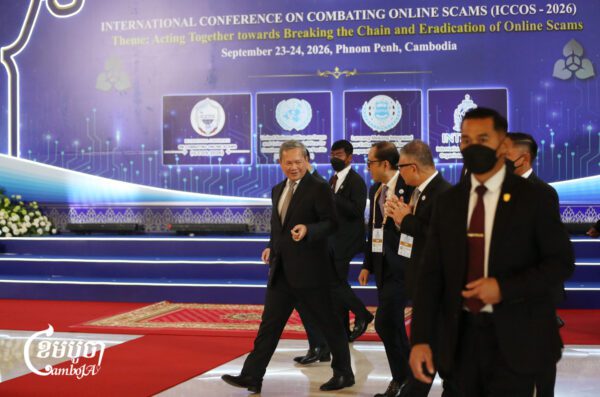
About 130 people attended the launch, including ministerial officials, diplomats, civil society groups, private sector representatives, international partners and youth groups. The event comes as Phnom Penh presses ahead with a nationwide crackdown it says will “eliminate” scam networks by April.
Rebecca Miller, UNODC’s regional coordinator for Southeast Asia and the Pacific, said the campaign is being rolled out across the region.
“UNODC invites civil society, digital platforms, youth leaders and governments to amplify the ‘Trapped In Scam Crime’ campaign,” she said.
UN Resident Coordinator Vladanka Andreeva said trafficking patterns are shifting fast, with organized crime groups exploiting digital tools and social vulnerabilities to coerce thousands into scam operations.
She said the issue is not just a law enforcement challenge but a serious human rights crisis, stressing that victims should be treated as trafficked persons, not offenders.
As crackdowns widened this year, authorities say about 250 scam sites and more than 90 casinos have been shut. More than 200,000 people have fled compounds and 10,000 have been deported, according to the government anti-cyber crime commission.
Local media and anti-trafficking experts have described the aftermath as a “humanitarian crisis,” with many escapees stranded without passports or money to return home.
UNODC also cited Interpol data showing that between 2020 and 2025, about 74% of identified victims trafficked into scam centers globally were brought to Southeast Asia.

Andreeva said the campaign adopts a survivor-centered approach shaped by victims’ experiences. Content will be available in nine languages, including Khmer, and be distributed through schools, universities, social media and trusted community networks.
“Prevention also requires certain cooperation with technology and online platforms such as the partnership with Meta,” she said, adding that traffickers often misuse social media to recruit victims or promote scams.
In a virtual presentation, Meta’s head of safety policy for Asia Pacific Malina Enlund said the company removed nearly 11 million Facebook and Instagram accounts in 2025 for violating fraud rules.
The U.S. tech giant, valued at more than $1 trillion, drew scrutiny last year after a Reuters report said it expected 10% of its 2024 revenue to come from ads linked to scams and banned goods. The company called the estimate “rough and overly-inclusive.”
Last month, an investigation by CamboJA News found recruitment for suspected scam operations in Cambodia via platforms such as Telegram and TikTok is ongoing.
Kelly Geoghegan, a political officer in the U.S. Embassy in Phnom Penh, said the United States strongly supports the UNODC initiative, noting that trafficking for forced criminality in scam centers threatens the dignity and security of individuals, families and communities, including American citizens.
The Cambodian government also welcomed the campaign. Mok Chansothea, deputy chief of the secretariat of the Ad Hoc Commission on Combating Online Scams (CCOS), said authorities are prioritizing prevention, enforcement and public awareness to educate people about online scams.
He said cybercrime offenders “must be punished without exception” and referred to a draft law targeting online scam operations.
While scam centers in Cambodia and across the region are found to rely heavily on forced or coerced labor from foreigners, concerns are also rising over Cambodians being recruited into the industry.
Heng Sokleap, a student at the University of Cambodia who attended the event, said she had heard of scam operations promising high salaries but did not fully understand how they work or the trafficking risks involved.
She said the campaign is especially valuable for Cambodian youth, particularly in rural areas, to help them recognize and avoid scam traps. She added that government and non-profit groups should hold grassroots workshops to raise awareness.
However, she said efforts to combat online scams will be more effective if corruption is addressed.