Listen to the audio version of this article (generated by AI).
“Online jobs” typically slow down in December, then rebound after Lunar New Year, said Sreynich*, a vendor in Sihanoukville, the coastal city notorious for hosting scam centers. The term is often used by Cambodians to refer to online scam work.
But this year is different. The roads are quiet. Buildings sit empty. Fewer people are working at sites suspected of running scams, she said. Her income has plunged by nearly 90%.
Sreynich is part of a wider ecosystem of vendors, shopkeepers and small businesses in border enclaves, areas long flagged by watchdogs and rights groups as hubs for scam operations, dependent heavily on the flow of workers tied to the illicit trade.
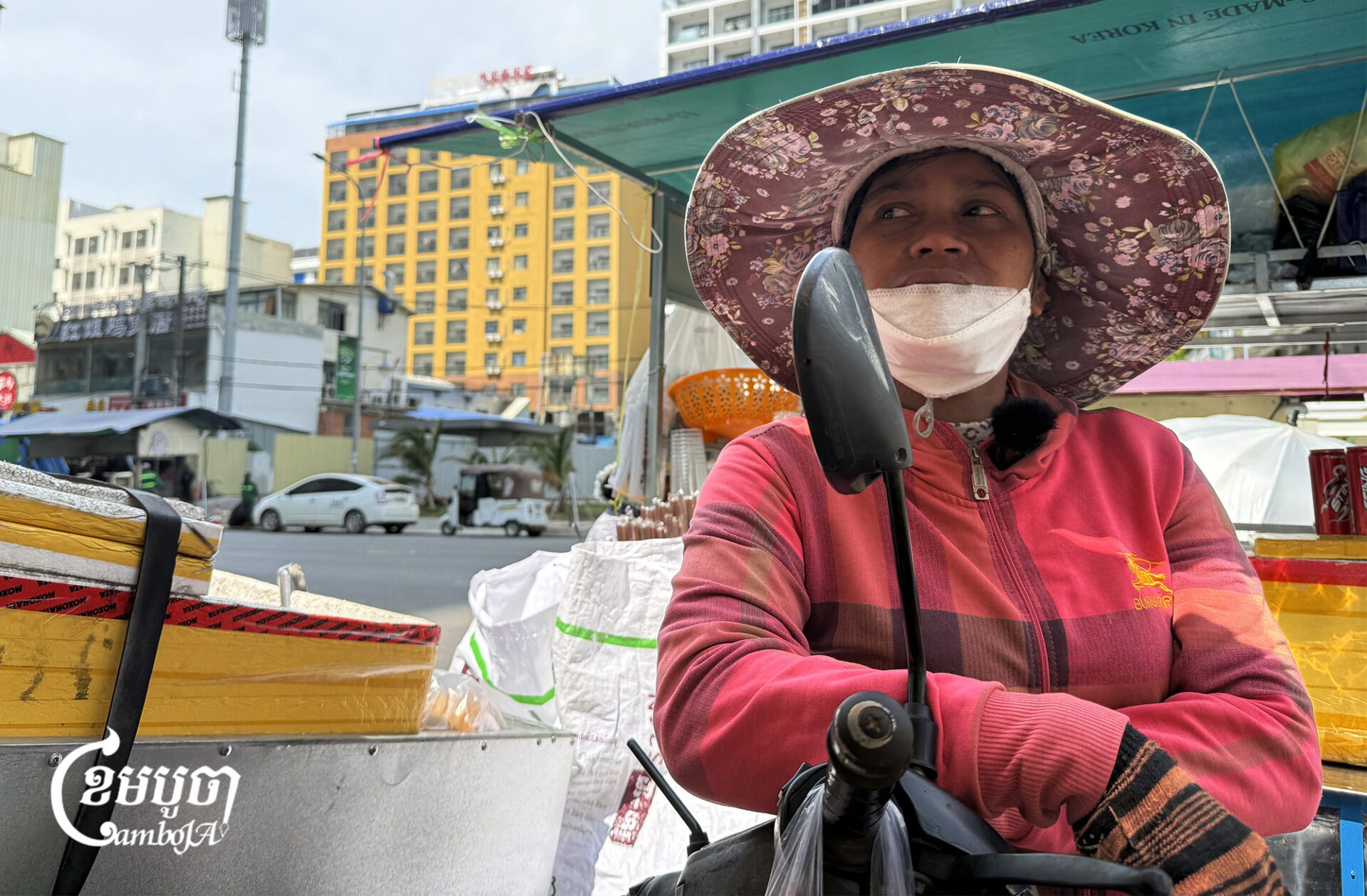
Three years ago, she left a garment factory job in search of better pay and moved to Sihanoukville. Now she sells snacks and drinks from a motorbike cart outside the “Chinatown” building and Jing Shui Casino. Both sites were reportedly raided earlier this year over suspected scam activity.
She said she cannot confirm what happens inside but believes it involves online jobs.
Before the crackdown, business was brisk. Sreynich said could earn up to $250 a day before expenses, more than most Cambodians make in a month. Much of that came from foreigners who would briefly leave the compounds during the day.
Now she makes less than $25 as the government widens an enforcement sweep following heightened international pressure.
The government says the sweep, dubbed Operation XXL, will “eliminate” scam centers by April. But questions remain over how long it will last, if linked elites will be held accountable, and how it will protect the more than 100,000 foreigners believed to be trafficked into hundreds of compounds across the country. Local economies built around the trade are now confronting their dependence.

Crackdown Hits Small Businesses
Since July, about 250 scam sites and more than 90 casinos have been shut, authorities said. More than 200,000 people have fled compounds and 10,000 have been deported, the government’s anti-cybercrime commission said earlier this month.
Although the government denies profiting from scam operations, an allegation raised in a U.S. State Department report last year, Prime Minister Hun Manet acknowledged the crackdown is hitting local businesses.
“I look at the economic and social system, and it is hurting our economy,” Hun Manet said at a conference in Phnom Penh in March. “It is affecting some of our local people with high salaries, and it is affecting some local businesses.”
But he rejected the idea that Cambodia’s economy depends on the scam industry, calling it a “black economy” that undermines the country’s “honest economy.”
A 2024 report by the United States Institute of Peace estimated online scam operations in Cambodia generate more than $12.5 billion annually, roughly half of the country’s GDP.
The most significant crackdown yet on the multibillion-dollar industry is already rippling through the informal economy.

Like most Cambodian adults that are in debt, Sreynich is struggling to repay a loan. Before the crackdown, she earned enough to cover her $300 monthly installment. Now she has asked her creditor to cut the payment by $100. The request was accepted.
Phly Chanthy, another vendor in Sihanoukville, said her income has also collapsed. She used to make about $50 a day selling desserts. Now she brings in less than $15.
“I do not know what to do. I sell outside almost every day until sunset. I feel frustrated. It is hard,” she said, tearful near the Lion King Casino, which was raided in February.
Chanthy has cut her prices in half. Her husband, a tuk-tuk driver, is also earning less.
“We do not know what to do to have money to pay the bank,” she said of the nearly $400 installment they pay each month. “I do not want to talk because when I do, it becomes too emotional.”
The strain on informal workers like Sreynich and Chanthy, who made up more than 88% of Cambodia’s workforce in 2024, highlights a complex fallout from a crackdown many say they support.
“I feel 50-50, happy and sad,” said food vendor Cheun Vichara. “I’m happy the illegal activities are cleaned up, but it also affects our income.”

Some vendors said they hope legal Chinese businesses and tourists will return to Sihanoukville.
Experts said more support is needed for those affected.
“From an economic justice perspective, efforts to eliminate illegal activities should be accompanied by support measures so that low-income women who were not involved in wrongdoing do not bear the heaviest economic burden of the transition,” said Eng Chandy, executive director of the Gender and Development for Cambodia.
Government spokesperson Pen Bona urged vendors who once relied on customers from scam compounds to “shift their businesses to areas with tourism or garment factories.”
He said support measures target all citizens, not only those affected by the crackdown. “The government is promoting tourism, building social infrastructure and improving roads and tourist sites to boost economic activity,” he said.
Other observers, such as Ear Sophal, Cambodian-American political analyst and associate professor at Arizona State University, said the impact is local for now, but restoring investor and tourist confidence is only possible if authorities truly dismantle scam networks and strengthen the rule of law.
“Confidence can begin to recover within a year or two,” he said.
Because recovery may take time, Sophal and Chandy said the government should treat the situation as a local livelihood shock. They called for short-term support such as temporary cash aid, debt relief talks with microfinance institutions, and small grants or low-interest loans to help affected vendors restart their businesses.
“These vendors are not criminals,” Sophal said. “They are casualties of an unhealthy local economy. If the state wants public support for a cleaner economy, it has to help people survive the transition to one.”
Outlook Uncertain
With a little over a month left before the government’s deadline to eliminate online scams nationwide, vendors said they are still waiting to see whether workers will return.
Based on past crackdowns, sites such as Lixin Harbour City, Chinatown and Jing Shui Casino were often repaired and reopened, Sreynich and Chanthy said.
If former scam centers remain closed, some vendors said they may return to their hometowns, while others may look for work in garment factories.
Development institutions also say the outlook is unclear.
Yasmin Siddiqi, Cambodia country director for the Asian Development Bank, said the full economic impact of shutting down scams is uncertain because their operations involve cross border networks.
“In the long term, the benefits of reducing scams will far outweigh the costs,” she said.

Tourism, which contributes about 10% of GDP, fell 23% in the second half of 2025. Border disruptions linked to a conflict with Thailand were a major factor, but scam-related security concerns also played a role, Siddiqi said.
“The strong government commitment to cracking down on scam activities will be critical for equitable and sustainable growth in Cambodia,” she added.
For vendors like Sreynich and Chanthy, the crackdown brings both hope and uncertainty. Ending scams could restore investor confidence and create new opportunities. But without support to help local economies adjust after years of dependence on the illicit trade, many say they do not know what comes next.
*Sreynich asked only that her first name be used due to privacy concerns.