Listen to the audio version of this article (generated by AI).
Cambodia decided to join U.S. President Donald Trump’s Board of Peace initiative as a founding member which is aimed at resolving conflicts globally, while an analyst says Cambodia will benefit from softer pressure from the U.S.
Prime Minister Hun Manet said Cambodia’s participation is a demonstration of its goodwill and strong commitment to global peace.
With regard to public concerns over potential financial obligations, he assured that the participation as a founding member for a three-year term would not incur any costs.
“I would like to verify that participation as a founding member of the Board of Peace for a three-year term does not require payment for funds,” he wrote on his Facebook on Tuesday, adding that the $1 billion payment is only for long-term permanent membership.
The decision to join the “Peace Council” follows US combat ship USS Cincinnati (LCS 20) calling at the Ream Naval Base in Preah Sihanouk and a meeting between Prime Minister Hun Manet and Admiral Samuel Paparo.
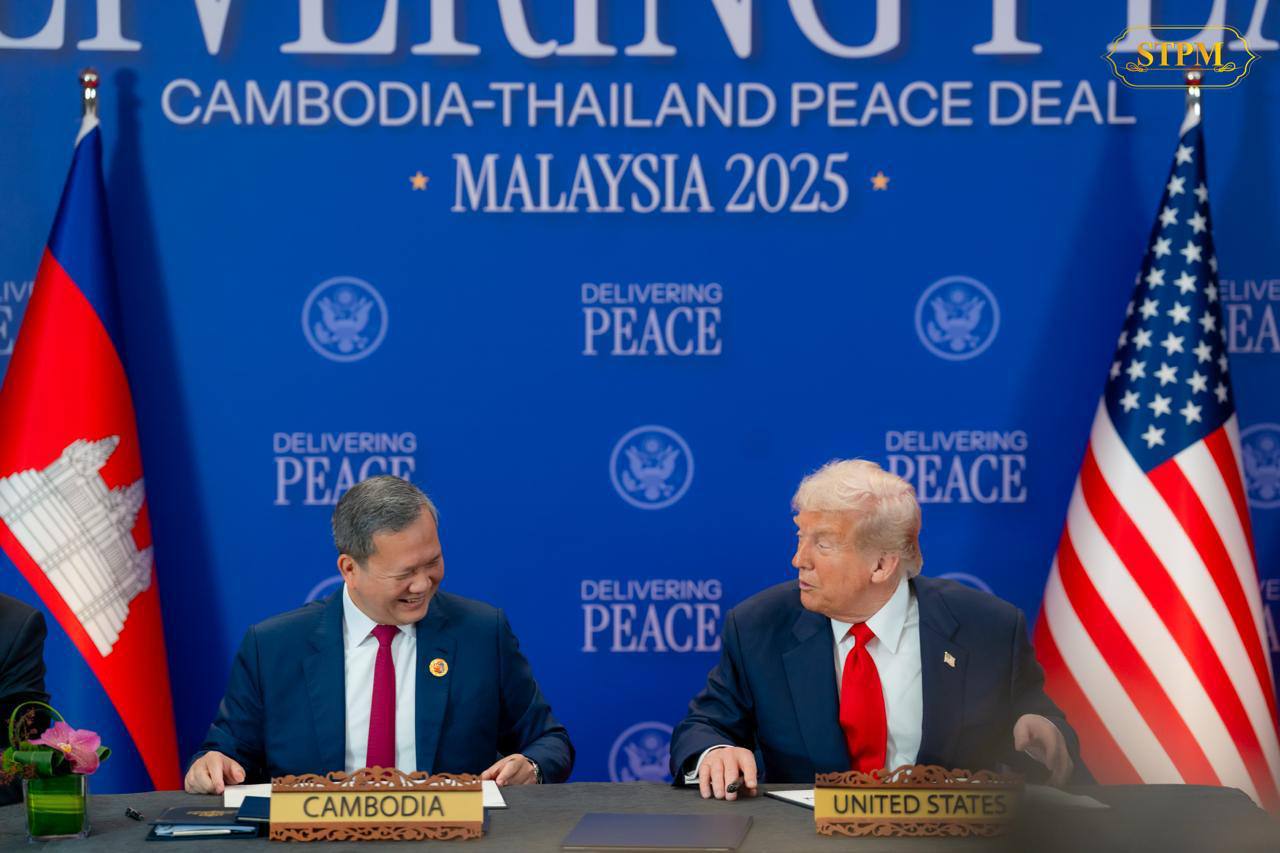
Hun Manet emphasized that the docking of U.S naval this time is a result of growing bilateral relationship, and gratitude to Trump for playing a major role in ensuring a ceasefire in the Cambodia-Thailand armed clashes. Trump witnessed the signing of the Joint Declaration in Kuala Lumpur on October 26 last year.
During the meeting, commander Paparo discussed the U.S.-Cambodian defense relationship and ways to strengthen bilateral ties and support for regional stability.
Paparo said that Trump continues to pay attention to the Cambodia-Thailand border situation and the implementation of the joint declaration, their support of the AOT mechanism and acceleration of the Joint Border Committee process in measuring and demarcating the border for both nations.
On January 16, Trump sent a formal invitation to Cambodia to join as a founding member state and become party to the Charter of the Board of Peace.
Roughly 60 countries were invited to join the “Board of Peace” but only 18 have confirmed their participation, and about 30 countries are expected to join, Associated Press reported.
France, Norway and Sweden declined the invitation, while the United Kingdom, the European Union’s executive arm, Canada, Russia, Ukraine, and China have not yet indicated their response to Trump’s invitations, the report said.
Independent Asia-Pacific geopolitical analyst Seng Vanly said that aligning with the Board of Peace provides Hun Manet with a “strategic rebranding” tool designed to neutralize persistent Western criticisms of its domestic political environment.
“This participation serves as a form of ‘diplomatic laundering’ where active cooperation on Middle East peace or post-conflict stabilization is used to argue that Cambodia is a responsible and essential international partner whose internal governance should be viewed with greater nuance or less interference,” he said.
“This move acts as a shield against the specific power domination pressures often exerted through U.S. sanctions and trade restrictions linked to democratic benchmarks,” he added.
By becoming a founding member of a high-profile U.S. initiative, the Cambodian government can pivot the international conversation away from the alleged negative record of human rights and democratic pluralism toward its role as a proactive contributor to global stability.
NGO rights group Adhoc president Ny Sokha said that there are positive signs in Cambodia becoming a member of the Board of Peace, as it could help safeguard peace at a time when the country is facing a potential war crisis with Thailand.
“Cambodia’s participation in the Peace Council may provide a platform to address or facilitate [dialogue] on this issue,” he said.
He noted that the current situation demonstrates the limitations of the UN Security Council, which has not shown a strong or effective response to the border conflict, nor to similar challenges occurring in other countries.
However, Sokha said there are controversial aspects to Cambodia joining as a founding member of the Board of Peace, particularly given the country’s close ties with China.
“At this time, Cambodia may face [diplomatic] friction with other countries. As we know, regional disputes continue to emerge, including China’s contentious relationship with Taiwan,” Sokha said.
He added that Cambodia has consistently supported the One China policy, raising questions about how Cambodia would position itself should China become involved in a major dispute.