Listen to the audio version of this article (generated by AI).
Kem Monovithya, the daughter of former president of opposition leader Kem Sokha, was appointed as a special envoy to Prime Minister Hun Manet, a post equivalent to a minister, a few days after a series of meetings.
The appointment was announced following a Royal Decree signed by King Norodom Sihanmoni released on August 17, 2026.
It comes on the heels of several symbolic encounters between Cambodia’s ruling elites and former opposition figures, raising questions whether the political landscape was being reshaped after years of rivalry between the ruling Cambodian People’s Party (CPP) and the now defunct-Cambodia National Rescue Party (CNRP).
However, treating them as the “dawn of a genuine political settlement or national reconciliation” would be premature, analysts said.
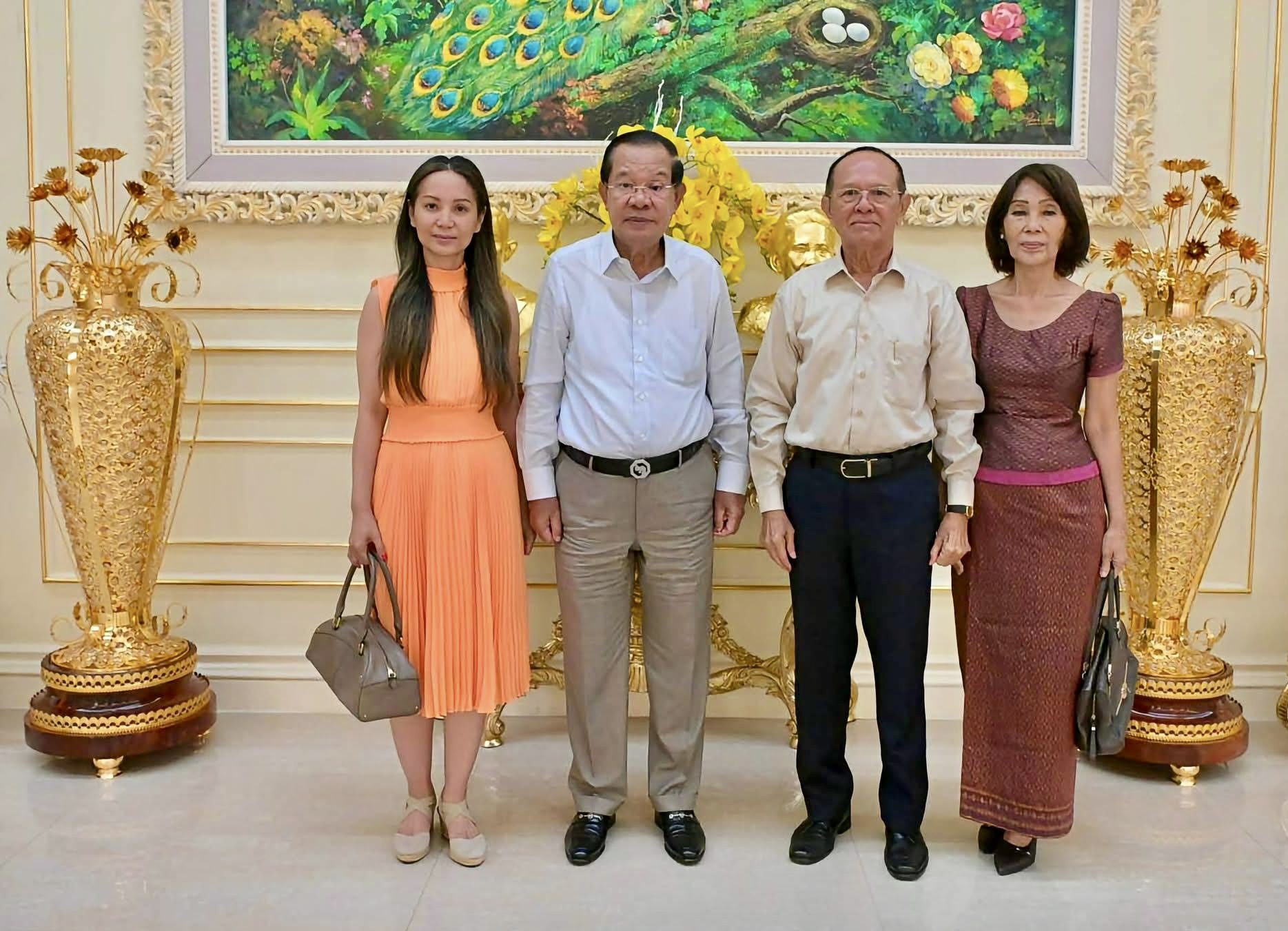
After years of rivalry, a meeting took place between Hun Manet and Monovithya, daughter of former CNRP leader, Sokha, followed by a three-hour meeting between Senate president Hun Sen and Sokha and his family. In the past, both parties mounted the strongest electoral challenge to a decades-long rule.
“Today, I had a conversation with Kem Monovithya. As new generation politicians, there are some things we can do together for the good of our nation, especially on the international stage,” Hun Manet wrote on his Facebook on August 14.
Ruling CPP spokesperson Chea Thirith, confirmed the meeting was an exchange of views between two politicians and showed a closer relationship between the two families.
Earlier, Cambodian Asia-Pacific geopolitical analyst Seng Vanly said the meeting marked a “tactical shift” in the political landscape. However, he stressed that treating the meeting as the dawn of a genuine political settlement or national reconciliation was “premature”.
“Without concrete legal action and reopening of democratic space, these encounters remain high-profile political gestures rather than the groundwork for a broad political settlement,” he remarked.
He said that true reconciliation requires structural legal remedies, such as restoring full political rights to opposition figures, dropping politically motivated chargers and releasing prisoners of conscience.
However, Vanly said Hun Manet’s engagement with Monovithya strongly signaled a generational political strategy aimed at reframing the ruling elite’s relationship with a younger demographic and modernizing the party’s image.
In May, Sokha received a partial royal pardon that removed his 27-year house arrest sentence for treason, followed by the lifting of his five-year foreign travel ban. He is still not allowed to participate in politics.
Kimsour Phirith, part of opposition leader Sam Rainsy’s faction, and now spokesperson for Khmer Will Party, said that the meeting was a “positive sign” for political reconciliation between politicians who had long treated each other as political enemies.
“I hope that an understanding could be reached to release prisoners of conscience like Thach Setha in order to demonstrate the willingness between two Khmer people,” he said.
“On a negative note, I am concerned that the meeting may not lead to a settlement between former political rivals but instead could be used to advance personal or group interests,” Phirith said.
There are many issues that need to be addressed, including border incursions and online scams, which the government needs to tackle at all levels, and the opposition parties in order to restore its image and rebuild trust among the people, he added.
Neil Loughlin, a senior lecturer in comparative politics at City St George’s, University of London, said the meetings and “warm words” from Manet about Monovithya suggest that the CPP and the family are “softening” their treatment of the Kem family after years of portraying them as “traitor” and agents of a “colour revolutionaries”.
But, it is too early to determine what the meeting “ultimately means”, with its significance probably becoming clear only later.
“The political settlement is still one in which the CPP sets the terms on which others operate, including Kem Sokha,” he said.
The CPP could begin to address that by freeing all political prisoners and activists and allowing free and open elections.
“It is positive that we have seen him [Kem Sokha] receive a partial pardon, but he is not the only political prisoner in Cambodia,” Loughlin said.
Clearly the CPP is trying to address the “terrible reputational damage” that it has “suffered” on the back of having industrialized scamming operations take root throughout the country, he said.
Loughlin cited that business figures who are CPP Senators have been sanctioned by the US, the UK, and others. The reputational and economic fallout has been significant.
“There have been massive repercussions for the banking sector, the tourism industry, among others, and it is ordinary Cambodians who are suffering because of this,” he said.
Political analyst Em Sovannara also said the meeting represented positive steps, notably the political engagement of Sokha’s daughter, who “might become affiliated with the government or move forward to form a political party”.
“In my opinion, Kem Sokha cannot do politics but he can support his daughter in politics,” he said.
Despite the top leaders’ meetings, political freedom and freedom of expression remain limited. “Freedom does not apply to all people.”
“We have seen some political parties still facing persecution, even for installing party signs, as we all have restrictions on the freedom of expression for politicians, journalists and the public,” he said.
He pointed to a scenario which is gaining popularity – Monovithya could join the Human Rights Party, form a new party or join an already-established party that supports Sokha’s side in which potentially to reduce in supporting the Nation Power Party.
Monovithya could not be reached for comment when contacted via Messenger, a social messaging app.