Thailand has fully enforced the closure of all land border crossings with Cambodia, restricting entry into the country, while allowing citizens who wish to return home.
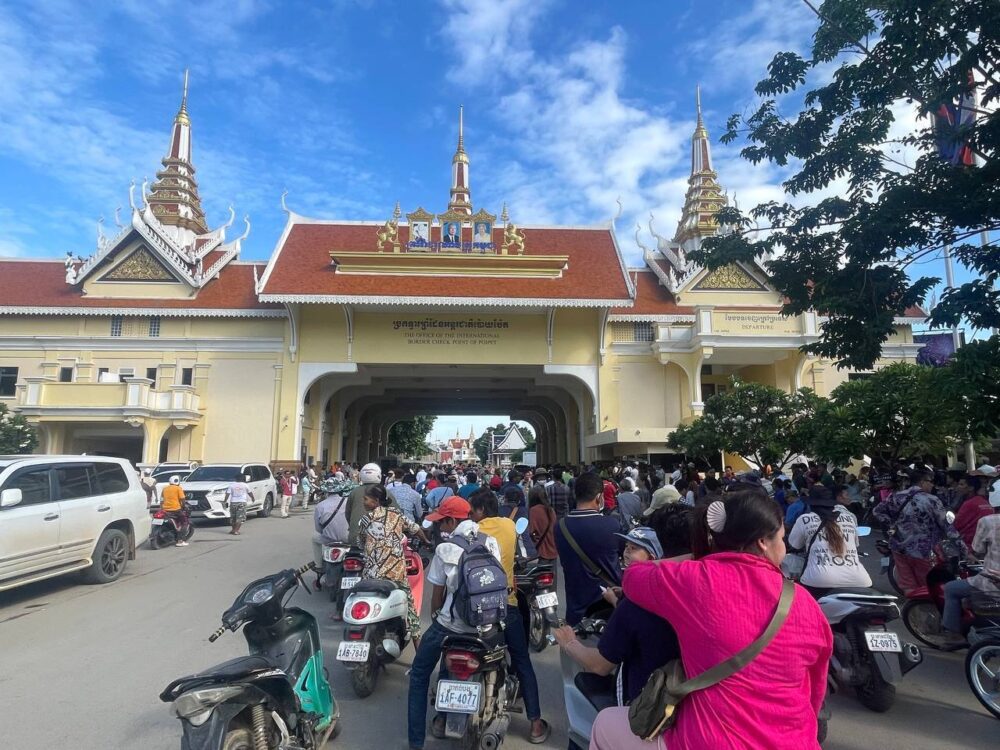
Some 300 people and tourists were stranded on Tuesday at the Poipet International border checkpoint, unable to enter Thailand. The closure was announced by the Thai military on Monday night, prohibiting entry to all travelers, trade, and vehicles, except students and medical patients.
Thailand’s unilateral decision to seal all seven Cambodian provinces that share a border with the country remains in effect, although authorities have reached a deal at a few border crossings to allow citizens to return to their respective countries.
Escalation of the border tension follows a fatal military clash on May 28 in the contested “Mom Bei” area, fueled by ongoing disputes over the ownership of the site where a meditation hall known as Sala Ruomchet, was burned down.
Thailand cut its operation hours along the border gates in a tit-for-tat move to Cambodia’s suspension of internet bandwidth purchase, Thai television broadcast and films, boxing, and imports of agricultural products and fuel.
Between January and May this year, bilateral trade amounted to $1.87 billion, General Department of Customs and Excise data showed. Cambodia exported $395 million worth of goods to Thailand and imported goods valued at $1.48 billion, indicating a trade deficit of around $1.1 billion.
Speaking at the Poipet checkpoint, Banteay Meanchey provincial governor Oum Reatrey said Cambodia has no desire to escalate the issue. “The problem is caused by the Thai side, not Cambodia. We have no intention of closing the checkpoints,” he said.
“As of now, they announced the complete closure of all border crossing checkpoints. There’s no need for you to come here anymore. If the situation changes, I will inform you through the city governor,” Reatrey told the press.
Separately, Ly Sovanarith, the provincial spokesperson, confirmed that Cambodian authorities are coordinating with the Thai side to allow Cambodian vendors operating in Rong Kluea Market to pass through if they wish to return home, including tourists.
Pailin provincial information department acting director Nhoeb Borey said the Thai side enforced the border closure at the Prum International border at 9 a.m. — but the two sides have reached an agreement to allow citizens to return to their respective countries.
Sok Sokny, Rong Kluea Market vendor, told CamboJA News that since the announcement of the border closure by the Thai military, his business has suffered and is not able to earn any income to support his family. The border tensions have resulted in citizens of both countries encountering financial difficulties.
“The Thai side said the border is closed and now I can’t earn money to support my family. The situation is really bad for us,” said Sokny.
Another business owner in Poipet City, Banteay Meanchey, who declined to be named due to safety concerns and fear of jeopardizing her business, lamented that her livelihood has worsened because the tensions have intensified.
She has been selling second hand clothes in Rong Kluea market, which she considers her second home, since 2000, and earned a good income which helps to sustain the family. The growing border tensions have cost her business as her “loyal customers”, including Thai people, are not buying from her now.
The clothes seller mentioned that other vendors and businesses are also facing a “miserable” time, expressing hope that the situation between Cambodia and Thailand will go back to normal and for the gates to open for people to continue their work.
If the border stays closed for a long period, those who have businesses at Rong Kluea market as well as people who live and work along the border, will face a financial crisis, she told CamboJA News.
“I’m speechless right now. Previously, we experienced an earthquake, flood, and fire at Rong Kluea and now we are facing border conflict. So, Thai people are not coming to buy my clothes like before. There are seven provinces along the Thailand border, but only Rong Kluea market consists of 90% Cambodian sellers. What should we do?” she said.
While the issue should be left to the governments to resolve, citizens should not be discriminating against each other, and become good neighbors again like in the past, she said, adding that she is struggling to pay her bank loan of about $200,000, which she took out to start her clothing business and to pay staff salary.
“We need to support each other as sellers at Rong Kluea. We have no tears left to cry. We are worried about paying our bank loans, losing our business and of a clash between Thailand and Cambodia. We are living in fear and have no choice,” she said.
Meanwhile, economic analyst Hong Vannak at the Royal Academy of Cambodia opined that bilateral relations and both sides’ economy will be impacted, however, Thailand will bear a greater burden due to its “more advantageous trade deposit”.
“Cambodia has diversified its economic integration significantly, which is why I said Thailand stands to lose more. Cambodia is less affected because it has shifted from relying on Thai imports to ordering goods from other countries to meet its needs,” he said.
“I want to clarify that, under current circumstances, both sides are facing pressure due to existing tensions. This situation is making political and economic relations, as well as people-to-people connections, increasingly difficult,” Vannak said.
He stressed that Cambodia reserves the right to apply countermeasures in response to any pressure placed by Thailand.
Cambodia has strengthened its commercial ties with various countries, particularly in the tourism sector, people-to-people exchanges, and partnerships in ASEAN, Asia, Europe, and America.