Listen to the audio version of this article (generated by AI).
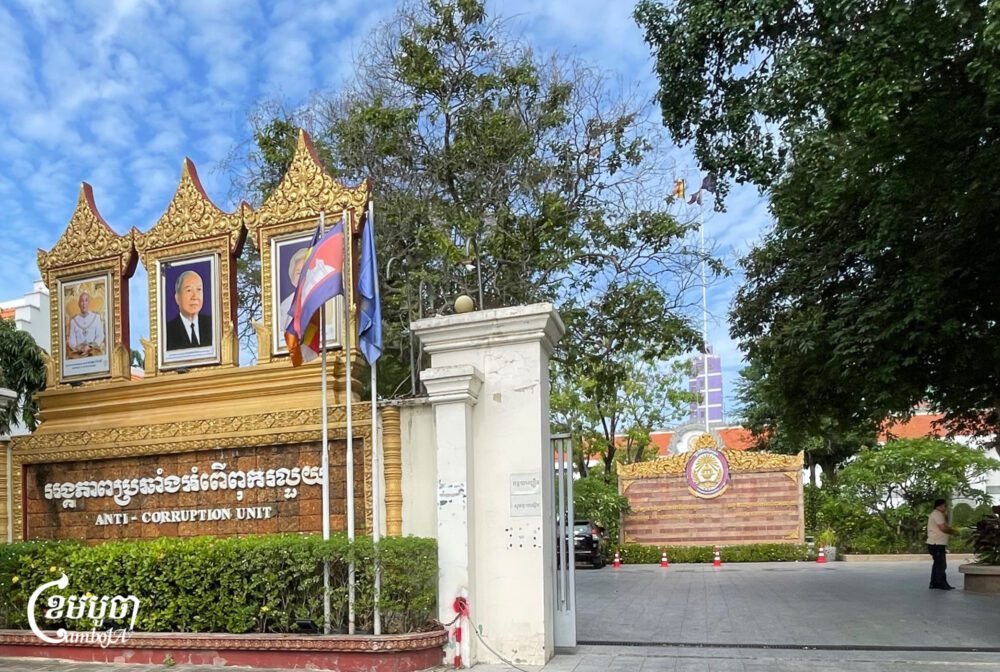
Cambodia’s corruption ranking worsened in 2025, according to Transparency International’s Corruption Perceptions Index (CPI), dropping one point compared to 2024–a finding which has been rejected by the Anti-Corruption Unit (ACU) because it does not reflect the “current reality”.
The report, released on Tuesday, showed that Cambodia scored 20 out of 100—down from 21 in 2024—placing it 163rd out of 182 countries and territories worldwide. Within ASEAN, Cambodia ranked second from the bottom, ahead of only Myanmar.
The 2025 CPI assesses perceived levels of public-sector corruption in 182 countries and territories, drawing on 13 independent data sources, including the World Bank, World Economic Forum, private risk and consulting companies, think tanks and others. The scores range from 0 (highly corrupt) to 100 (very clean).
In ASEAN, Cambodia continues to rank among the most corrupt nations, second to Myanmar, which maintained its 2024 score of 16. Vietnam recorded a slight improvement, rising to 41 from 40 in 2024. Thailand’s score declined from 34 to 33, while the Philippines dropped from 33 to 32. Indonesia saw a notable decrease from 37 to 34, while Laos improved slightly from 33 to 34. Malaysia gained two points, while Singapore remained among the world’s cleanest countries, ranking third globally.
The latest CPI results reveal a troubling decline in anti-corruption performance even among democracies traditionally viewed as stronger than autocracies or flawed systems, including the United States, the report stated.
Transparency International noted that cuts to U.S. funding for overseas civil society groups have weakened global anti-corruption efforts and emboldened political leaders in some countries to further restrict independent voices, including NGOs and journalists.
Cambodia ranked 161 out of 180 countries on the 2025 World Press Freedom Index by Reporters Without Borders, placing it among the 42 countries where press freedom is considered “very serious.”
This situation is reflected in the February 3, 2026 arrest of journalist Hem Vanna, publisher of HVNN TV Online in Banteay Meanchey province following his report of a suspected online scam compound. He was charged with incitement, and is believed to be the fifth journalist in pre-trial detention since January 2025 for work-related reporting. Cambodian civil society and media organizations have called for his immediate release.
“Corruption is not inevitable. Our research and experience as a global movement fighting corruption show there is a clear blueprint for how to hold power to account for the common good, from democratic processes and independent oversight to a free and open civil society,” François Valérian, Chair of Transparency International, said.
“At a time when we’re seeing a dangerous disregard for international norms from some states, we’re calling on governments and leaders to act with integrity and live up to their responsibilities to provide a better future for people around the world.”
Government spokesperson Pen Bona did not respond at the time of publication.
ACU spokesperson Soy Chanvichet dismissed Transparency International’s report, saying it does not reflect the current reality in Cambodia, though he noted it could still be considered as reference material in anti-corruption efforts.
He said Cambodia has been a member of the United Nations Convention against Corruption (UNCAC) since 2007, describing it as a global anti-corruption framework that does not rank or score countries but instead offers legal recommendations and best practices for member states to adapt to their own contexts.
Chanvichet added that Cambodia has received two UN monitoring missions, which he said have contributed to improved governance. However, he acknowledged that further work is needed, particularly through three key measures: public education on anti-corruption laws and consequences, preventive efforts, and strict law enforcement through the investigation and prosecution of corruption cases without exception.
Executive Director of Transparency Cambodia, Sin Putheary, told CamboJA News that the report can serve as a useful tool for reflection and for identifying mechanisms to improve anti-corruption efforts.
“The CPI is an important indicator that can help strengthen investor confidence in Cambodia, while also encouraging the government to find ways to improve the country’s economic performance,” she said.
Putheary added that to make meaningful progress in combating corruption, the government must adopt comprehensive solutions, which include the expanding and respecting freedom of expression, passing the draft Law on Access to Information, strengthening governance within state leadership, holding officials at all levels accountable for corruption-related crimes, and ensuring fair competition for the private sector.
Meanwhile, CPI said even countries with the least corrupt public sectors can still face serious integrity issues, such as allowing illicit funds to move across borders and into money-laundering schemes, which CPI did not capture.
Despite ranking as the world’s third least corrupt country, Singapore had been linked to forgery and money-laundering investigations involving Cambodia’s Prince Holding Group and its founder, Chen Zhi, who was deported to China over alleged scam operations. Singaporean authorities seized more than $150 million in assets, including a yacht, 11 cars, and luxury liquor, as part of the probe.